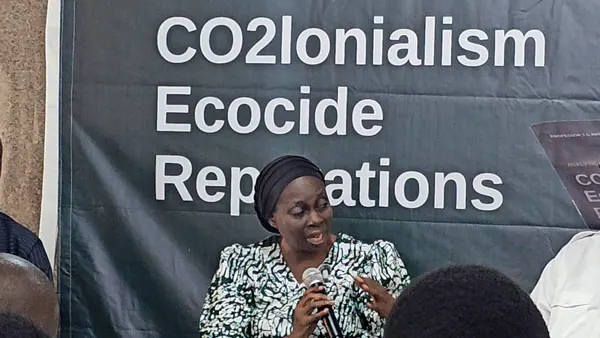
A recent panel discussion at the University of Lagos has brought attention to the issue of colonial reparations, with a legal expert challenging the United Kingdom's position on the matter. Dr. Asikia Karibi-Whyte, an expert in jurisprudence and international law, argued that changes in political leadership do not change the identity of the state under international law. This stance has implications for Britain's potential responsibility for colonial-era environmental damage.
The discussion was part of a broader examination of whether environmental destruction associated with colonial rule can be incorporated into African reparations claims. A new research report, "CO2lonialism, Ecocide and Reparations," examines the ecological legacy of colonial rule in Africa and documents the consequences of colonial economic systems. The report argues that these ecological consequences should be subjected to rigorous assessment and monetary valuation.
Dr. Karibi-Whyte's argument centers on the concept of the United Kingdom as a continuing state entity, irrespective of changes in government personnel. She cited the "Certain Phosphate Lands in Nauru" proceedings before the International Court of Justice as an important precedent. The case involved environmental devastation caused by phosphate mining during the colonial period and demonstrated that environmental damage associated with colonial administration can become the subject of an international legal claim.
The report's lead author, Professor J. G. Nkem Onyekpe, highlighted the significance of the ecological dimension of colonial extraction. He cited a 2022 peer-reviewed estimate valuing resources appropriated from the Global South through unequal exchange at more than $10 trillion in 2015 alone. A comparable analysis extended across the full period of colonial rule and affected African states could potentially run into the hundreds of trillions.
Professor Nnagugwu Oscar Uluocha, Professor of Geography at the University of Lagos, reinforced the environmental dimension of the argument. He described the ecological damage inflicted on Nigeria under British colonial rule as "colossal." The report's findings and recommendations are expected to inform the development of a common African approach to reparations.
The report is set to be submitted to the African Union's Committee of Experts on Reparations and Legal Reference Group on Reparations. This submission is part of efforts to develop a unified African stance on reparations for colonial-era wrongdoing. The issue of colonial reparations remains a contentious topic, with many African countries seeking redress for historical injustices.
The discussion at the University of Lagos highlights the ongoing debate surrounding colonial reparations and the role of international law in addressing historical injustices. As the African Union continues to push for reparations, the arguments presented by Dr. Karibi-Whyte and others are likely to play a significant role in shaping the conversation.
Key points
- The UK's position on colonial reparations has been challenged by a legal expert who argues that changes in government do not absolve the state of past wrongdoing.
- A new research report documents the ecological consequences of colonial economic systems and argues for rigorous assessment and monetary valuation of environmental damage.
- The report's findings are expected to inform the development of a common African approach to reparations.