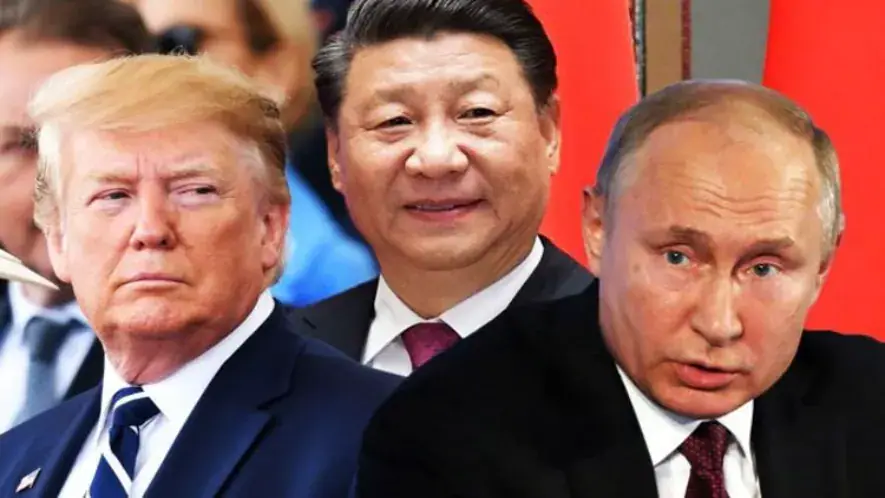
On the second and final day of the APEC summit in Shenzhen, China, a rare and highly anticipated meeting took place between the leaders of the world's three largest military and economic powers: China, the US, and Russia. Chinese President Xi Jinping, US President Donald Trump, and Russian President Vladimir Putin gathered on the sidelines of the summit, sparking hopes of a new era of cooperation and dialogue between the nations. The meeting was described by Chinese Foreign Ministry spokesperson Mao Ning as "groundbreaking" and "pioneering," with the potential to promote peace and stability globally.
The meeting comes at a time of heightened tensions and conflict around the world, including the ongoing war in Ukraine, which is entering its fifth year, and the crisis in the Gulf, which has significant implications for the global economy. The three leaders face pressing issues, including the need to control nuclear arms, address climate change, and promote free and fair trade. According to Mao Ning, the leaders discussed the need for "changes necessary to guarantee the safeguard of world peace and promote strategic stability in relations between the major powers."
The meeting is seen as a significant development in the complex relationships between the three nations, which have been marked by tensions and competition in recent years. The US and China have been engaged in a trade war, while the US and Russia have been at odds over issues such as Ukraine and election interference. The three leaders have also been engaged in a struggle for influence and dominance in various regions, including the Middle East and Asia.
One of the key issues on the agenda is the control of nuclear arms, with the US and Russia possessing large arsenals and China seeking to expand its own capabilities. The US has urged China to join talks on nuclear disarmament, but China has been hesitant, citing concerns about its own security and the need for the US and Russia to reduce their arsenals first. The leaders also discussed the need for cooperation on issues such as counter-terrorism and cybersecurity.
The meeting has sparked hopes of a new era of cooperation between the three nations, but analysts remain skeptical about the prospects for significant progress. According to Jeffrey Sachs, a professor at Columbia University and a specialist in geo-strategy and geo-economics, the meeting is likely to be seen as a battle for influence and dominance in the new world order. The three leaders have competing visions for the world, with China and Russia seeking to challenge US dominance and promote a more multipolar world.
The meeting also comes ahead of a potential showdown between the US and China, with the US reportedly planning to impose new tariffs on Chinese goods. The US has also been critical of China's human rights record and its military expansion in the South China Sea. Russia, meanwhile, has been engaged in a conflict with Ukraine and has faced criticism from the US and Europe over its actions.
The outcome of the meeting is uncertain, but it is clear that the three leaders face significant challenges in promoting peace and stability in a rapidly changing world. As Mao Ning noted, the meeting has the potential to be "groundbreaking" and "pioneering," but it remains to be seen whether the leaders can make significant progress on the many issues that divide them. The meeting has sparked hopes of a new era of cooperation, but it also highlighted the many challenges that lie ahead.
Key points
- The meeting between Xi Jinping, Donald Trump, and Vladimir Putin has the potential to promote peace and stability globally.
Reporting sources
- Donald Trump e Vladimir Putin encontram-se com Xi Jinping... · novojornal.co.ao