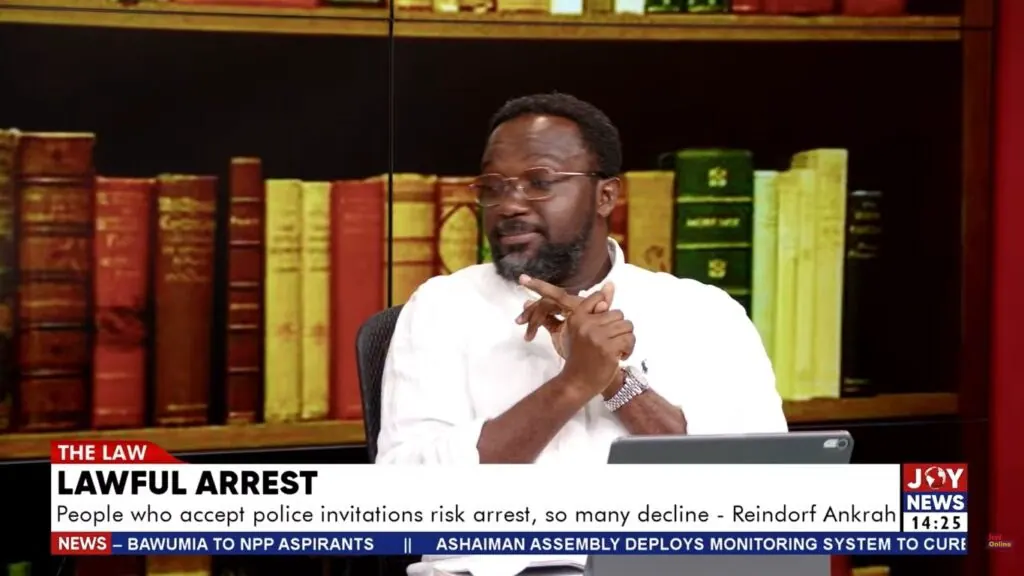
Ghanaian legal practitioner Reindorf Twumasi Ankrah has expressed concern that citizens are increasingly hesitant to respond to police invitations due to fear of arrest. According to Twumasi Ankrah, years of invitations turning into arrests have bred deep distrust between citizens and law enforcement. He made these remarks while speaking on JoyNews' The Law programme on 4 October 2026. Twumasi Ankrah serves as acting Chief Executive Officer of the Ghana Integrated Aluminium Development Corporation (GIADEC).
Twumasi Ankrah explained that many people now deliberately refuse to honour invitations, instead telling investigating officers to formally exercise their powers of arrest. This allows individuals to be aware of their status as suspects from the outset. He acknowledged that invitations remain a legitimate investigative tool, particularly in cases where officers need to clarify facts or obtain documents. However, repeated conversions of invitations into arrests have left ordinary Ghanaians wary of cooperating with the police.
The lawyer advised anyone attending an invitation to bring a lawyer along as a precaution against potential unexpected changes during questioning. He also argued that once officers prevent a person from leaving, they must acknowledge that the encounter has become a detention and respect the individual's constitutional rights accordingly. This warning comes as a case involving the detention of an NPP MP by the Economic and Organised Crime Office (EOCO) has drawn criticism.
The case involves Manhyia South MP Nana Agyei Baffour Awuah, who was granted GHS10 million bail following a tense standoff with EOCO. The MP's party, the NPP, demanded an apology from EOCO over the incident, which was described as an attempted arrest. Critics, including Sulemana Braimah of the Media Foundation for West Africa, have warned that the case risks appearing like a political power play unless allegations against Baffour Awuah are substantiated with charges.
Former NPP national chairman Freddie Blay called the EOCO detention "bizarre" and "comical," questioning why the agency pursued a lawyer and sitting MP while organised crime figures remain unaddressed. The incident has sparked debate about police and investigative agency conduct in Ghana. EOCO is a specialised state agency responsible for investigating and prosecuting economic and organised crime, including corruption and money laundering.
It remains unclear whether EOCO or the Ghana Police Service plan to respond formally to Twumasi Ankrah's remarks or announce changes to invitation procedures. Additionally, it is unclear whether charges have been filed against Baffour Awuah following his release on bail. The issue of police invitations leading to arrests has significant implications for trust between citizens and law enforcement in Ghana.
The warning by Twumasi Ankrah highlights the challenges faced by law enforcement agencies in building trust with the public. The repeated conversion of invitations into arrests can have far-reaching consequences, including discouraging potential witnesses from coming forward. This can ultimately hinder investigations and undermine the pursuit of justice in Ghana.
Key points
- Citizens are increasingly hesitant to respond to police invitations due to fear of arrest.
- The repeated conversion of invitations into arrests has eroded trust between citizens and law enforcement.
- The issue has significant implications for investigations and the pursuit of justice in Ghana.