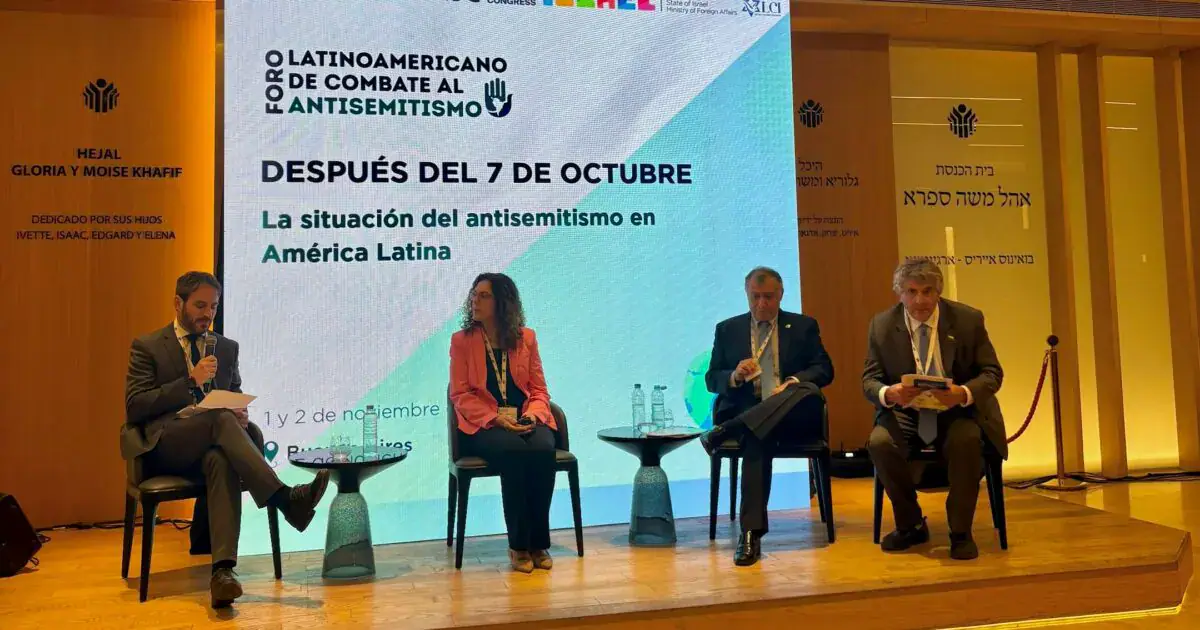
The Latin American Forum to Combat Antisemitism, jointly organised by Israel's Ministry of Foreign Affairs and the Latin American Jewish Congress, took place on November 1 in Buenos Aires. The forum brought together more than 250 Jewish leaders and officials from 13 countries to discuss how to combat antisemitism across Latin America. Participants examined aspects of contemporary antisemitism, including its evolution in Latin America since October 7, its spread across digital platforms, and the distortion and trivialisation of the Holocaust.
Ahuva Spieler Reshef, Israel's ambassador to Argentina, emphasised the importance of defending historical truth in the face of rising antisemitism. "If hatred has gone viral, let us make the democratic courage to defend historical truth an unstoppable force," she said. "History is not written by those who remain silent; it belongs to those who choose to keep the conversation going." The forum also discussed how prejudices imported during the Spanish conquest persist in the region today.
Marcos Peckel, director of the Confederation of Jewish Communities of Colombia, highlighted how conspiracy theories about Jews controlling the world can thrive without any personal acquaintance with Jewish life. He pointed to an entry in the Royal Spanish Academy's dictionary associating the word "Jew" with "miserly" as an example of prejudice preserved by an institution that helps shape the Spanish language. Peckel also noted that in Colombia, someone warning another person not to cheat them might use the expression "No me haga la judía," which associates Jews with dishonesty.
Fernando Lottenberg, the Organization of American States (OAS) commissioner to monitor and combat antisemitism, compared the situation in the region pre-October 7 to Gabriel García Márquez's Chronicle of a Death Foretold. "The warning signs of antisemitism in Latin America were already there," he said. "It took October 7 for things to reach an extraordinary scale. Now Zionism has become a dirty word." Lottenberg urged the adoption across Latin America of the International Holocaust Remembrance Alliance (IHRA) definition of antisemitism.
The forum also discussed how anti-Israel sentiments frequently crossed into open anti-Jewish intimidation in the wake of the October 7 attacks and the war that followed. Lottenberg noted that the right supports Israel, while the left opposes Israel, making it a partisan issue. Marcos Peckel added that many Jews come from the left and have helped build left-wing movements, but today the left is slamming the door in their faces.
Fabiana Loguzzo, Argentina's representative to the IHRA, highlighted the importance of strengthening Holocaust education in the region. She noted that Argentina holds the IHRA presidency this year and has outlined its vision for its term, which includes bringing Holocaust remembrance to regions beyond the countries where it occurred. Argentina is Latin America's only full member of the IHRA, while Uruguay has observer status and Paraguay has expressed interest in joining.
Claudio Epelman, executive director of the Latin American Jewish Congress, emphasised that the rise of antisemitism after October 7 and its new manifestations in the region demand commitment, cooperation, and coordinated action. "Incidents targeting Jews are not, in themselves, what make our societies antisemitic," he said. "A society becomes antisemitic when those incidents are not confronted, when they are not prevented, and when people remain silent and indifferent."
Key points
- The Latin American Forum to Combat Antisemitism was jointly organised by Israel's Ministry of Foreign Affairs and the Latin American Jewish Congress.
- The forum discussed the evolution of antisemitism in Latin America since October 7 and its spread across digital platforms.
- Participants urged the adoption of the International Holocaust Remembrance Alliance (IHRA) definition of antisemitism across Latin America.