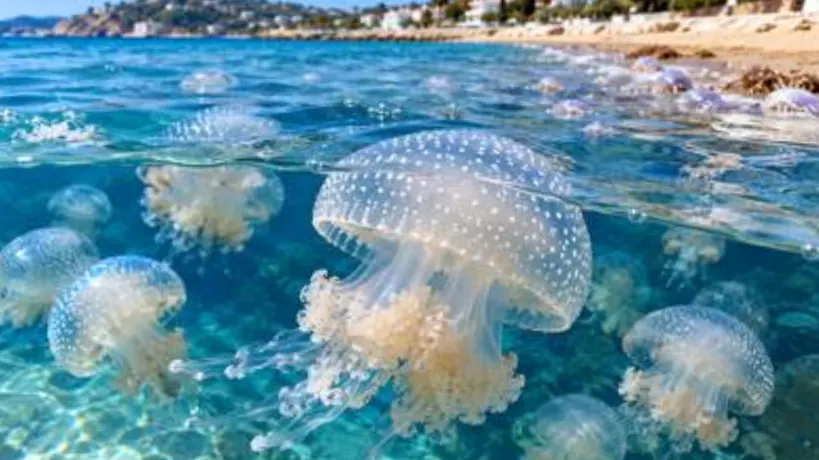
A Tunisian science association, "Tun- Sea", has reported that a large number of white-spotted jellyfish, also known as "fire jellyfish", have appeared on beaches in the Gulf of Tunis, particularly in Mersa, Gammarth, and Hammam Sousse. The association warns that this could lead to increased pressure on available food and subsequently on the marine food chain as a whole.
The white-spotted jellyfish feeds on zooplankton, small creatures that live in water and are an essential food source for many marine animals. The association notes that this species is native to the Western Pacific Ocean, but has been transported to other regions through maritime transport. The jellyfish has been documented to consume fish eggs and larvae, as well as crustaceans, and has been known to disrupt fishing activities by accumulating in fishing nets.
The white-spotted jellyfish is characterized by its rounded, semi-transparent bell, covered with white spots, and can reach a diameter of approximately 50 cm. The first documented scientific observation of this species in Tunisia was in August 2012, in Lake Bizerte, where small jellyfish were spotted, followed by adult jellyfish between September and November of the same year.
The species reappeared in 2013, indicating the presence of a local breeding population. The association notes that it is more accurate to describe the current situation as a new wave of large numbers of this alien species, rather than a first appearance. The jellyfish's sting is usually mild and barely noticeable, and it is not considered a highly hazardous species to humans.
The "Tun- Sea" association is calling on citizens to report any sightings of this species in the sea or on beaches, providing details such as the location, date, and time of the sighting, as well as photos or videos. This information will help experts to track the species and monitor its spread and population changes.
The association emphasizes that citizen participation in monitoring jellyfish is valuable, as demonstrated by scientific experiments in the Mediterranean. By tracking the white-spotted jellyfish, researchers can gain a better understanding of its impact on the marine ecosystem and take necessary measures to mitigate any negative effects.
The appearance of large numbers of white-spotted jellyfish on Tunisian beaches highlights the need for continued monitoring of marine ecosystems and the importance of addressing the issue of alien species. The "Tun- Sea" association's efforts to raise awareness and gather information on this species are crucial in understanding and managing its impact on the marine food chain.
Key points
- The white-spotted jellyfish feeds on zooplankton, which is an essential food source for many marine animals.
- The species has been known to disrupt fishing activities by accumulating in fishing nets.
- Citizen participation in monitoring jellyfish is valuable in tracking the species and monitoring its spread and population changes.