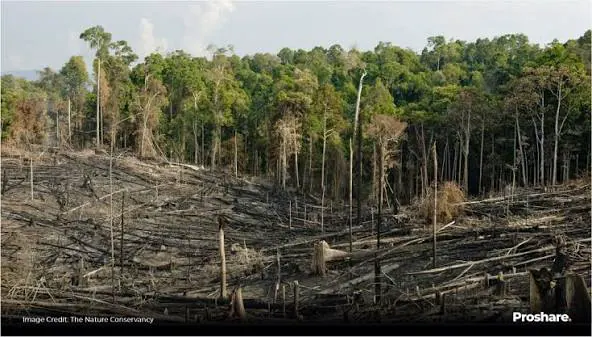
Residents of Lagos State have expressed concerns over the loss of trees and green spaces to urban development, saying the trend has increased their exposure to heat. Many have noted significant changes in their environment over the years, with civil servant Mrs Abiodun Adebayo recalling that the Lagos State Secretariat, Alausa, once had mature trees and extensive patches of greenery. However, much of the greenery has disappeared as paved surfaces, buildings, and other infrastructure have expanded.
Adebayo and other residents have pointed out areas that were once shaded by trees but are now largely bare. NAN's observation also showed noticeable changes in the area's vegetation compared with a 2024 photograph of the same location. Mr Adishun Okita, who has lived around Funsho Williams Avenue, Surulere, for about five years, said he remembered seeing orange and mango trees in the area, which provided shade and a natural breeze.
Okita said he began noticing the removal of trees about two years ago as shops and other structures emerged on previously green spaces. He said a mango tree he valued was cut down for infrastructure, while an orange tree in front of his house was removed to make way for a shop. The loss of trees has affected residents' daily lives, with Okita noting that they used to gather beneath the trees during power outages to escape the heat and play draughts.
Mr Mohammed Sani, a trader around Iponri Bridge, said the reduction in trees had changed the way people worked outdoors. Sani, who has traded in the area for seven years, said trees previously provided protection from direct sunlight for traders and residents. He noted that traders had resorted to various measures to protect themselves and their goods from intense sunlight, including using umbrellas.
Mrs Ngozi Afamefuna, a resident of Haruna, Ogba, said County Hospital had been her family's hospital for more than 20 years. She recalled that the hospital environment was greener and cooler around 2016 and 2017, with trees providing shade for patients and visitors. Afamefuna urged the government to strengthen measures against indiscriminate tree felling, saying protecting trees would benefit both residents and the environment.
Research has supported the residents' concerns, with a 2024 study published in the International Journal of Biometeorology finding high heat-stress conditions in highly urbanised parts of Lagos. The researchers recommended increased tree canopy and green spaces to mitigate the effects of heat stress. Another 2024 study recorded 4,017 trees belonging to 46 species across Lagos' 16 Local Government Areas.
The Lagos State Government has emphasised the need to balance urban development with the protection and expansion of green cover. Gov. Babajide Sanwo-Olu said anyone who unlawfully felled a tree without a permit was required by law to replace it with five trees. The residents have urged authorities and developers to prioritise tree preservation and incorporate more green spaces into urban planning as Lagos continues to expand.
Key points
- Residents blame urban development for the loss of trees and green spaces in Lagos, leading to increased heat stress.
- Research supports the need for more trees and green spaces to mitigate heat stress in urban areas.
- The Lagos State Government has implemented measures to protect trees and promote green spaces.