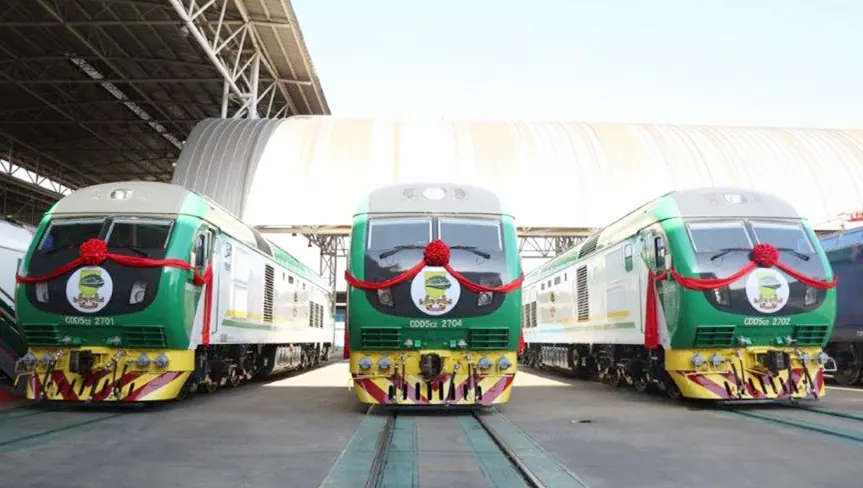
The Lagos-Ibadan railway, built by the China Civil Engineering Construction Corporation (CCECC), has been in operation for nearly 1,000 days. By March 2024, it had carried more than 2 million passengers. This performance is better than earlier episodes in Nigeria's railway history but still falls short of initial projections. The Nigerian Railway Corporation (NRC) had forecast hauling 4.3 million tonnes of freight and 12 million passengers in 2013.
The standard-gauge network, including Lagos-Ibadan and Abuja-Kaduna, transported 3.89 million passengers in 2025, generating N7.77 billion in fare revenue. In the first quarter of 2025 alone, 929,553 passengers and N1.95 billion in revenue were recorded. Despite this, the railway's daily ridership across the country is modest, with under 11,000 passengers per day. The line runs only three trips daily in each direction, and tickets are cash-only, not available online.
The financial gap is significant, with historical data showing that fare income covered only about 40 per cent of operating expenses in 1978, which fell to roughly 14 per cent by 2004. Even after the standard-gauge investment, revenue recovery has stayed well below sustainable levels. The NRC's managing director, Dr Kayode Opeifa, acknowledged that the corporation operates at a loss and has had to borrow money to keep trains running.
The high cost of diesel makes efficient operation almost impossible. Passenger fares do not fund the railway's upkeep; government transfers and debt do. Direct federal funding to the NRC totalled roughly N300 billion between 2016 and 2026, while federal borrowing for rail infrastructure over the same period exceeded N5 trillion. The 2025 federal budget allocated N41.49 billion specifically to rail projects.
Facing rising diesel, security, and maintenance costs, the NRC is considering a significant fare increase. However, this is politically sensitive, especially after offering temporary discounts during festive periods. Rail economists caution that publicly owned railways worldwide are typically built as a social service rather than a commercial one, and profitability is not usually their founding purpose.
Analysts argue that Nigeria's railway remains lopsided towards passenger haulage while neglecting freight, the segment that subsidises passenger services in most profitable rail systems abroad. According to an insider source, the NRC last recorded a profit in 1964. Lagos State's own light-rail Blue Line has posted stronger relative growth, carrying about 3.5 million passengers in 2025 with daily ridership reaching 15,000.
The Lagos-Ibadan line and urban commuter rail face different demand profiles and should not be conflated in ridership comparisons. The NRC is now weighing options to address the financial gap and ensure the sustainability of the railway. A structural solution, rather than a Nigeria-specific one, may be required to address the challenges facing the railway.
Key points
- The Lagos-Ibadan railway has carried over 2 million passengers since its opening in June 2021.
- The railway's financial gap is significant, with fare income covering only a fraction of operating expenses.
- The NRC is considering a fare increase to address rising costs, but this is politically sensitive.