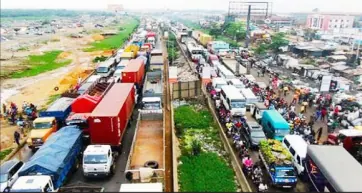
The Lagos-Ibadan Expressway, a vital link between Nigeria's commercial capital and the South-West, is facing immense pressure due to its high traffic volume. As the principal gateway to virtually every region of the country, the expressway serves hundreds of thousands of private vehicles, commercial buses, articulated trucks, fuel tankers, and container-laden trailers daily, making it one of West Africa's busiest highways.
Despite its strategic importance, the expressway, particularly the Lagos axis, has become synonymous with gridlock, crashes, delays, and commuter frustration. Motorists face a daily test of endurance, with trips that should take less than an hour stretching into several hours due to accidents, broken-down trucks, or emergency repairs. In extreme situations, motorists have been forced to spend the night on the highway.
The Lagos-Ibadan Expressway was originally designed decades ago when the population of Lagos and Ogun states was only a fraction of what it is today. Massive urban expansion has transformed communities along the corridor into densely populated residential and commercial centres, resulting in an enormous traffic volume that places tremendous pressure on the road almost every hour of the day.
While the recent reconstruction has improved the pavement and expanded portions of the carriageway, transport experts argue that widening the highway alone cannot permanently solve its congestion problems. The absence of effective alternative road networks running parallel to the expressway means that whenever an accident occurs, movement on the entire corridor virtually comes to a standstill.
Transport planners criticize the lack of parallel service corridors and interconnected access roads incorporated into the reconstruction project. Such roads would allow local traffic to bypass major incidents while long-distance travellers continue on the expressway. The rapidly growing settlements along the corridor require properly planned road networks that connect seamlessly with adjoining communities.
The Kara Bridge, a strategic location serving both interstate travellers and daily commuters entering Lagos, has witnessed repeated repairs, structural maintenance, tanker accidents, and prolonged traffic disruptions. Transport engineers believe regular structural assessments, preventive maintenance, improved drainage, and stricter traffic control around the bridge are essential to reducing disruptions.
The human cost of the expressway's challenges is a significant concern, with pedestrians risking their lives attempting to cross the expressway due to insufficient or inconveniently located pedestrian bridges. Motorists also face serious dangers from reckless driving, fatigue caused by prolonged traffic congestion, and indiscriminate stopping by commercial vehicles.
Key points
- The Lagos-Ibadan Expressway requires a multi-faceted approach to address its challenges, including infrastructure development, smarter traffic management, and alternative road networks.
- Transport experts emphasize the need for stricter traffic control, improved safety measures, and investment in rail freight to reduce the overwhelming number of heavy trucks transporting cargo by road.
- The government should consider constructing additional parallel road networks, dedicated truck holding bays, and expanding mass transit systems to alleviate the expressway's congestion problems.