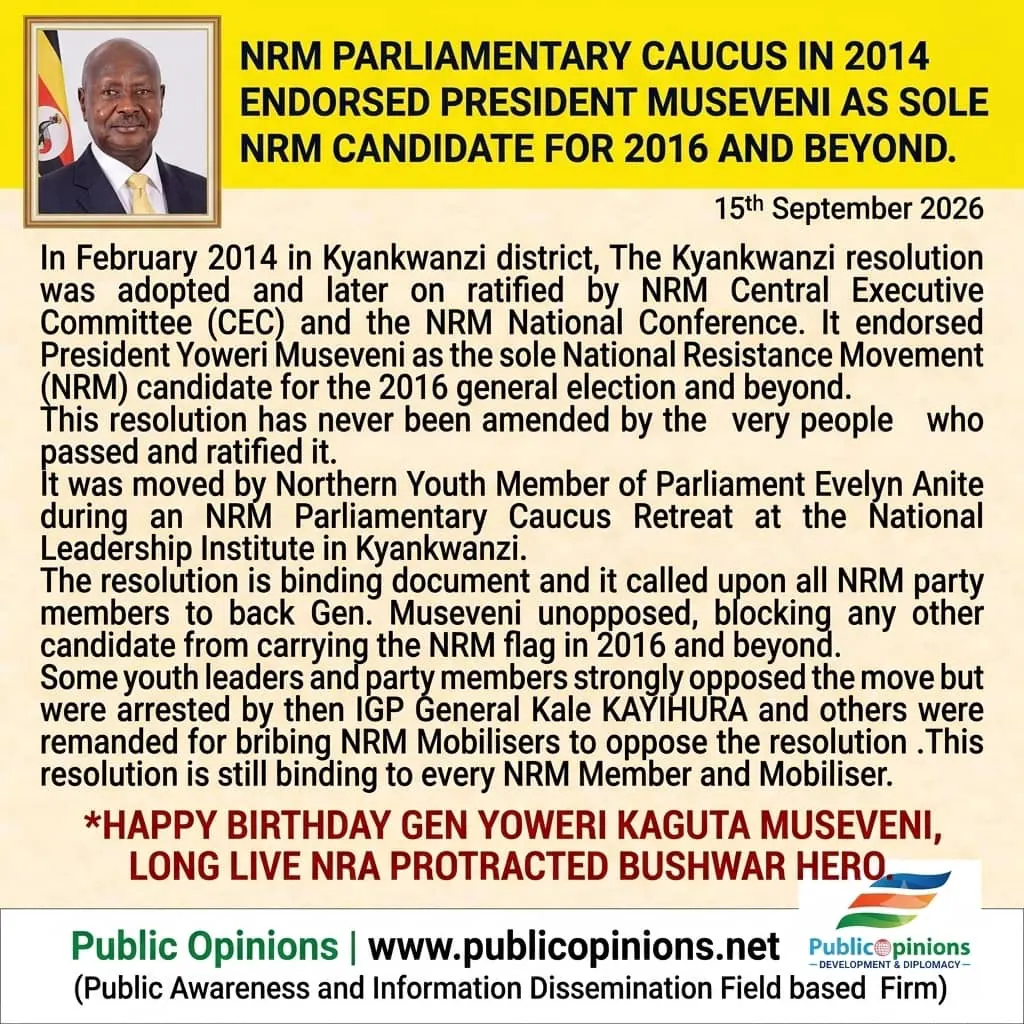
The 2014 Kyankwanzi resolution, which endorsed President Yoweri Kaguta Museveni as the National Resistance Movement's sole candidate for the 2016 general elections and beyond, continues to shape the party's political direction. According to Public Opinions, the resolution was adopted in February 2014 during an NRM Parliamentary Caucus retreat held at the National Leadership Institute in Kyankwanzi District. The resolution was moved by then Northern Youth Member of Parliament Evelyn Anite.
The Kyankwanzi resolution was later ratified by the NRM Central Executive Committee and the NRM National Conference. Public Opinions argues that because the bodies that adopted and ratified the resolution have not formally amended it, its principles continue to influence the party's political direction. The resolution has been a significant reference point in the ruling party's affairs.
The Kyankwanzi resolution was met with opposition from some youth leaders and other NRM members who argued that endorsing a sole candidate undermined internal competition within the party. The disagreement led to arrests of some individuals during the period. Under then Inspector General of Police Gen. Kale Kayihura, several dissenters were arrested and accused of attempting to bribe party mobilisers to reject the endorsement.
Despite the opposition, the sole-candidate resolution remained in place and was subsequently embraced by the wider NRM leadership. Public Opinions says Museveni and the NRM leadership remain committed to the principles associated with the Kyankwanzi resolution. The organisation argues that continued leadership under Museveni is important for maintaining organisational stability and pursuing Uganda's long-term development objectives.
The NRM's ideological foundation is linked to the Ten-Point Programme, formulated in 1984 during the liberation struggle. The programme outlined objectives including restoration of democracy, guaranteeing personal security, promoting national unity, defending Uganda's independence, developing a self-sustaining economy, restoring social services, fighting corruption, supporting displaced populations, promoting regional cooperation and maintaining a mixed economy.
Some of these historical objectives continue to shape government programmes, including agricultural commercialisation, import substitution and grassroots wealth-creation initiatives such as the Parish Development Model (PDM). Supporters of Museveni contend that his continued leadership is necessary to advance Uganda's long-term socio-economic transformation, infrastructure development and industrialisation agenda.
Public Opinions maintains that the continued reference to the Kyankwanzi resolution reflects the NRM's position that Museveni remains central to implementing both the party's historical objectives and its contemporary development agenda. The organisation links the Kyankwanzi resolution to the broader ideological principles of the NRM, which include Patriotism, Pan-Africanism, Socio-Economic Transformation and Democracy.
Key points
- The 2014 Kyankwanzi resolution remains influential in the NRM's affairs.
- The resolution was met with opposition from some youth leaders and NRM members.
- Museveni's continued leadership is seen as crucial for Uganda's long-term development objectives.