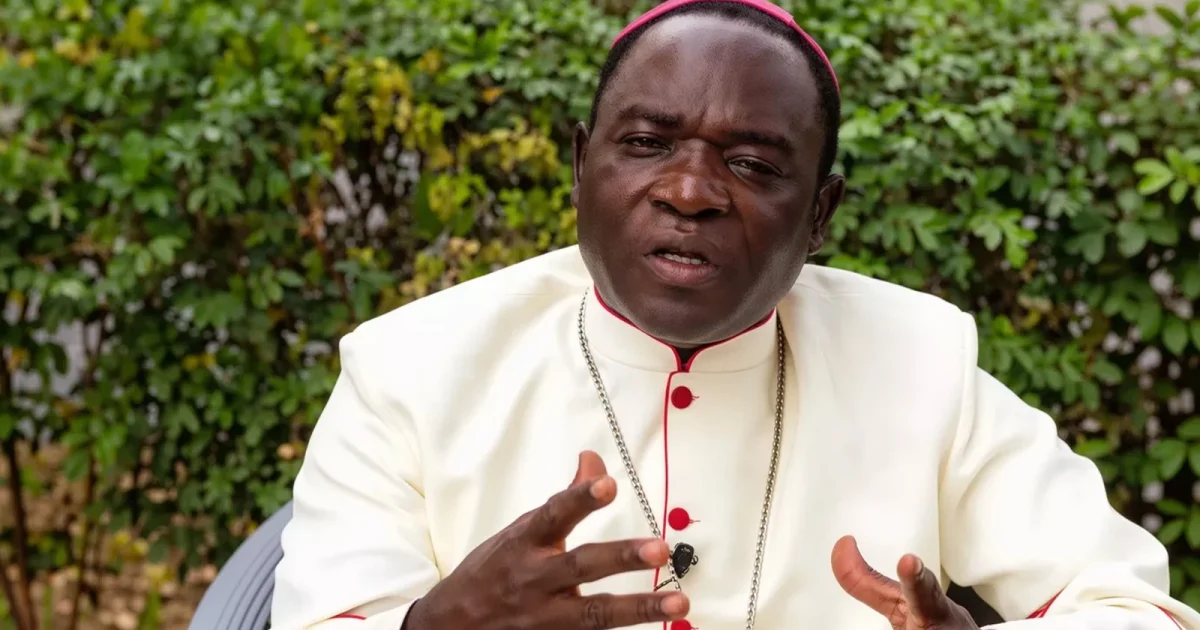
The Catholic Bishop of Sokoto Diocese, Bishop Matthew Hassan Kukah, has urged the Catholic Church in Nigeria to renew its values and reclaim its influence in public life. He made this call on Friday at St. Finbarr’s College Auditorium, Akoka, Lagos, while delivering a lecture titled, “To Conquer or to Serve? Thoughts on the Contributions of the Catholic Church to Human Development and the Making of a Good Society in Nigeria.” The lecture was organised in commemoration of the late Rev. Fr. Denis Slattery.
Kukah drew on the concept of “soft power” developed by the late American political scientist, Joseph Nye, to emphasize that lasting influence is achieved through service, attraction, and transformation of human lives rather than coercion. He cited the missionary approach to evangelisation, which established schools, hospitals, and other institutions across Nigeria, as an example of how soft power can shape the preferences of others.
The Sokoto bishop expressed concern that many Catholics appear to devote more time, resources, and energy to social, political, ethnic, and fraternity associations than to activities within their parishes and the Church. He warned that repeated commitment to such organisations could gradually shape people’s priorities and public decisions, and that failure to transmit Catholic values to younger generations could have serious consequences for the Church and society.
Kukah defended the contribution of Christian missionaries to Nigeria’s development, particularly in education and healthcare. He said the missionaries viewed salvation not merely as preparation for the afterlife but as a call to improve human life on earth. The Catholic Church, he noted, operates more than 231,000 schools and universities in 171 countries, educating about 72 million students.
In Nigeria, the Catholic Church has about 5,100 nursery, primary, and secondary schools, excluding its universities and other tertiary institutions. Kukah cited several missionary schools that contributed to the development of Nigeria’s elite, including Christ the King College, Onitsha; Queen of the Rosary College, Onitsha; Holy Rosary College, Enugu; St. John’s College, Jos; St. Louis College, Jos; St. Louis College, Kano; and St. John’s College, Kaduna.
Kukah urged alumni of these schools to reflect on how the values they acquired through Catholic education had influenced their subsequent contributions to society. He recalled the strict discipline associated with Catholic schools, including the roles played by priests, religious sisters, teachers, and principals in mentoring students, and challenged the Catholic community to look beyond preserving its institutions and focus on ensuring that the values that inspired the missionary enterprise continue to influence Nigeria’s homes, professions, politics, and public life.
The bishop concluded by emphasizing that renewal requires these schools, hospitals, and universities to carry conviction again into the lives of those who pass through them. He encouraged Catholics to prioritize their faith and ensure that its values are reflected in their daily lives, warning that erosion of these values could have far-reaching consequences for the Church and society.
Key points
- - The Catholic Church in Nigeria must renew its values and reclaim its influence in public life. - The Church operates over 5,100 schools in Nigeria and 231,000 globally, educating millions of students. - Failure to transmit Catholic values to younger generations could have serious consequences for the Church and society.