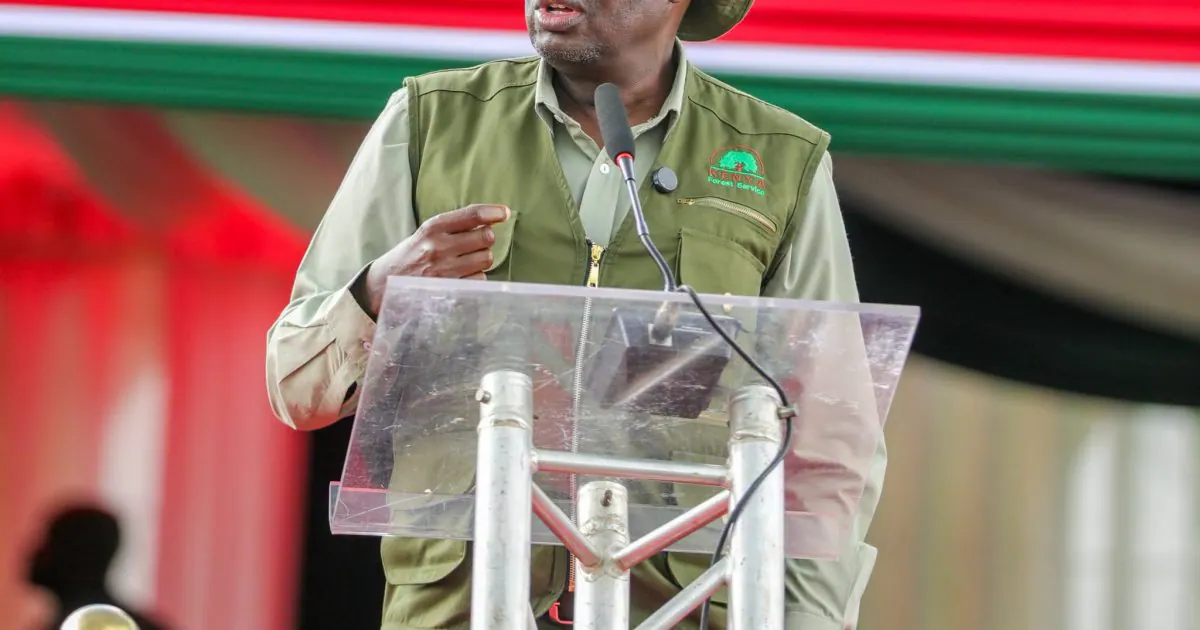
Chief of Staff and Head of the Public Service, Felix Koskei, has praised the impact of the Mau Forest Complex Integrated Conservation and Livelihood Improvement Programme (MFC-ICLIP), citing its role in restoring degraded ecosystems and improving livelihoods for thousands of households living around Kenya's largest water tower. The programme combines ecosystem restoration with sustainable livelihoods, reflecting the government's commitment to environmental sustainability and community empowerment. This initiative is expected to benefit thousands of households through clean energy and improved livelihoods.
The MFC-ICLIP is a 10-year, Sh21.5 billion initiative spanning over 317,000 hectares across major forest blocks, including Eastern, Western, Molo, and South-West Mau. The programme aims to reverse historical deforestation, illegal encroachment, and unsustainable land use by combining ecosystem restoration with community economic empowerment. Launched by President William Ruto in October 2025, the programme has grown into a broad partnership bringing together national and county governments, development partners, private sector players, schools, conservation groups, and local communities.
Koskei emphasized that the government is committed to achieving the 15 billion tree target in the next ten years, as outlined in President William Ruto's environmental plan. The MFC-ICLIP has already restored more than 1,500 hectares of degraded forest through the planting of approximately 1.5 million tree seedlings in the Marindas and Gacharage restoration sites. The initiative has also attracted significant support through its Adopt-a-Forest campaign, with leaders and institutions collectively adopting 1,635 hectares for restoration.
The programme has also invested in various community projects, including the rehabilitation of Kenyatta Dam and Mengit Dam, and the construction of milk coolers at the Kapteta and Milikwen Farmers Milk Cooperative Societies. In June, the State Department for Irrigation announced a Sh480 million rehabilitation of Kenyatta Dam under MFC-ICLIP, expected to support approximately 1,800 households through irrigation covering about 1,200 acres.
Koskei called on professionals from Kuresoi South, Kuresoi North, Njoro, Molo, and Rongai Sub-Counties to actively engage in the MFC-ICLIP to ensure local communities reap its full benefits. He noted that Nakuru's agricultural potential could provide a strong foundation for improving household incomes while reducing economic pressure on the Mau ecosystem. The Chief of Staff encouraged professionals to use their knowledge, networks, and expertise to support initiatives that promote productive agriculture, value addition, and sustainable use of natural resources.
Principal Secretary for the State Department for Environment and Climate Change, Dr Engineer Festus Ng'eno, explained that the MFC-ICLIP was specifically designed to tackle environmental degradation while simultaneously enhancing the livelihoods of communities residing near the forest. Dr Ng'eno stressed that the Mau's conservation must incorporate livelihood opportunities because communities living around the ecosystem are central to its long-term protection.
The Mau Forest Complex is one of Kenya's most critical water towers, supporting livelihoods, biodiversity, and climate resilience across the region. Protecting forests and water catchments remains critical as Kenya grapples with the growing effects of climate change and mounting pressure on natural resources. Healthy ecosystems are essential for sustaining agriculture, securing water supplies, and supporting livelihoods for future generations.
Key points
- The MFC-ICLIP has restored over 1,500 hectares of degraded forest through the planting of 1.5 million tree seedlings.
- The programme aims to benefit thousands of households through clean energy and improved livelihoods.
- The initiative requires an estimated funding of Ksh21 billion over 10 years, equating to approximately Ksh2.1 billion annually.