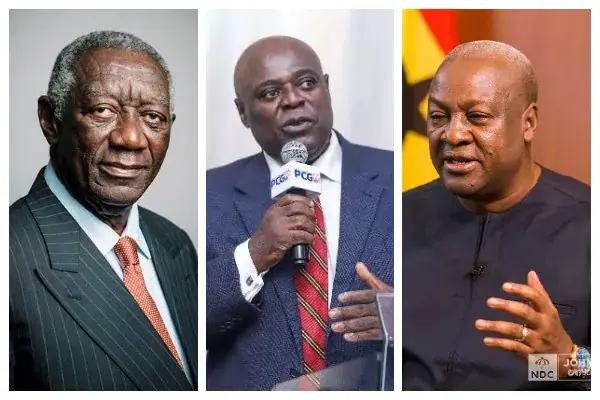
Former Deputy General Secretary of the National Democratic Congress (NDC), Samuel Koku Anyidoho, has expressed sadness over his party's current defense against cocaine-trafficking allegations, citing the NDC's past use of similar tactics against the New Patriotic Party (NPP). In a social media post on November 13, 2026, Anyidoho recalled that during his tenure as Head of Communications at the Osu Castle Kuku Hill Campaign headquarters between 2006 and 2008, the NDC used cocaine-related allegations to pressure then-President John Agyekum Kufuor and the NPP.
Anyidoho stated that the NDC went as far as coining a nickname for its rivals, calling them the "Narcotics Peddlers Party." He expressed regret over the damage caused to the NPP's image and now feels pained by the self-inflicted damage to his party's image. Anyidoho posed the question: "Who will weep for us if we have buried ourselves alive in cocaine??????" His comments have added a new dimension to the debate over who bears responsibility for the recent cocaine seizures linked to Ghana.
The controversy surrounding cocaine trafficking allegations has led to a tense sitting in Parliament on November 12, 2026, where Minority MPs chanted "Cocaine!" and "Cocaine economy!" and brandished placards accusing the government of running a "scam government." The protest followed news of a 2.6-tonne cocaine seizure linked to Ghana by Spanish authorities at the Port of Valencia. This is one of several interceptions abroad that have been tracked, including a total of nearly 14 tonnes of cocaine traced to Ghana seized since January 2025.
The issue has also revived scrutiny of warnings previously raised by Member of Parliament Ntim Fordjour. A spokesperson for former Education Minister Yaw Osei Adutwum argued that the state spent more energy discrediting those warnings than investigating them. Separately, IMANI Africa's Franklin Cudjoe has called for accountability 'from the top' over the string of cocaine busts, describing the country as having become a crime scene.
Anyidoho's acknowledgment of the NDC's own history with cocaine-themed political attacks has sparked a new conversation. His comments follow a long line of criticism from various stakeholders, including the NPP, who have accused the NDC of being hypocritical in their response to the allegations. The NDC has yet to respond to Anyidoho's statements.
The cocaine seizures have led to a heated debate between the NPP and the NDC, with each party trying to shift the blame to the other. The controversy has also raised questions about the government's handling of the issue and the impact on Ghana's international reputation. Anyidoho's intervention has added a new layer of complexity to the debate.
As the debate rages on, stakeholders are calling for a more nuanced approach to addressing the issue. They argue that the focus should be on finding solutions to the problem rather than engaging in partisan politics. The government has yet to respond to the allegations, but it is clear that the issue will continue to be a major talking point in the coming days.
Key points
- Former NDC communications chief Samuel Koku Anyidoho criticizes his party's response to cocaine trafficking allegations.
- The NDC had previously used cocaine-related allegations to pressure the NPP during the 2006-2008 period.
- The controversy has led to calls for accountability and a more nuanced approach to addressing the issue.