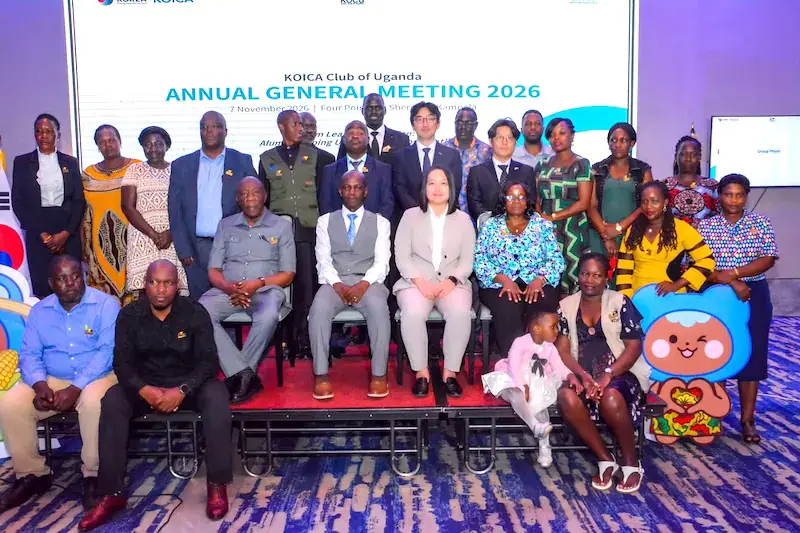
Ugandans who have benefited from South Korean scholarships and training programmes have been urged to apply their knowledge and skills to practical initiatives that address community needs and support national development. This call was made during the 2026 Annual General Meeting of the KOICA Club of Uganda, held at Four Points Hotel. The meeting brought together representatives of the Embassy of the Republic of Korea, government officials, social entrepreneurs, journalists, and development partners.
The meeting, held under the theme "From Learning to Action," aimed to reflect on the work of the alumni, reconnect, and plan future initiatives. Uganda and South Korea have maintained diplomatic relations for over six decades, with human resource development being a key area of cooperation. Through the Korea International Cooperation Agency, Global Korea Scholarship, and Korea Foundation for International Healthcare, South Korea has supported nearly 1,500 Ugandans through postgraduate scholarships and professional training programmes.
The 2026 Annual General Meeting marked the first time alumni from the three programmes attended the same event, providing an opportunity to strengthen cross-sectoral networks and explore how their training could contribute to Uganda's development priorities. Dasom Shin, head of cooperation at the Embassy of the Republic of Korea in Uganda, emphasised that the partnership between the two countries was built on people and urged the alumni to regard themselves as important partners in sustaining relations between Uganda and South Korea and advancing national development.
KOICA country director Jongsu Yi challenged the alumni to ensure that the training they received in South Korea translated into tangible results back home. He encouraged them to build professional networks across education, health, infrastructure, digital governance, and agriculture, saying a strong alumni association could make a meaningful contribution to Uganda's development. The alumni association, KOCU, has provided a platform for members to share expertise, undertake community initiatives, and strengthen cooperation between Uganda and South Korea.
One example of an alumnus applying his training locally is Arnold Ayebazibwe, who received a KOICA scholarship to pursue a master's degree in Agriculture Production and Food Security at Kyungpook National University in Daegu, South Korea. After returning to Uganda, Ayebazibwe was promoted to senior agriculture officer and became involved in community development initiatives. He has applied the knowledge acquired during his studies to mobilise communities to plant high-value and fruit trees, an initiative aimed at improving household livelihoods while promoting environmental conservation.
The establishment of KOCU has enabled alumni to contribute to Uganda's National Development Plan IV and the United Nations Sustainable Development Goals. In 2026, KOCU members conducted community sensitisation activities on sanitation and hygiene, clean cooking, and briquette-making. They also supported the planting of high-value and fruit trees in districts including Ntungamo, Kabale, Gomba, and Masaka. At the AGM, members reviewed the association's achievements and discussed resource mobilisation and strategies to ensure its long-term sustainability.
KOCU intends to remain a platform through which professionals trained in South Korea can contribute to Uganda's agricultural development, healthcare delivery, energy transition, and digital transformation. The association's activities cover knowledge exchange, economic empowerment, environmental protection, energy transition, information and communications technology literacy, and education. By applying their skills and knowledge, KOICA alumni can make a meaningful impact on community development and national growth.
Key points
- KOICA alumni are urged to apply their South Korean training to community initiatives that address local needs and support Uganda's national development.
- The KOICA Club of Uganda provides a platform for alumni to share expertise, undertake community initiatives, and strengthen cooperation between Uganda and South Korea.
- Nearly 1,500 Ugandans have benefited from South Korean scholarships and training programmes across various fields.