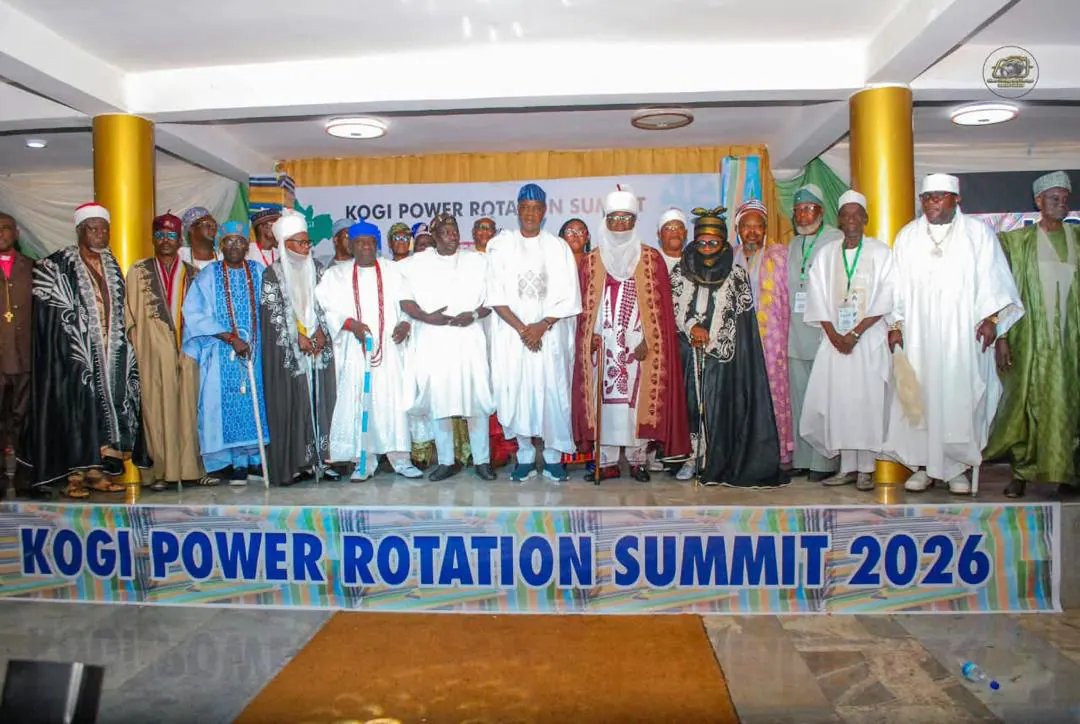
A two-day summit convened by the Kogi Unity Accord in Lokoja has reached a broad agreement on the need for political power rotation in Kogi state. The summit, attended by traditional rulers, religious leaders, and various stakeholders, recognized power rotation as a mechanism for promoting fairness, unity, and peaceful coexistence. The majority view supports an eight-year rotational arrangement, starting in 2032, allowing Governor Ahmed Usman Ododo to complete his second term.
The summit's communiqué, issued on October 1, emphasized that rotation should not displace considerations of competence, integrity, and leadership ability. Participants also recommended the development of a broad-based framework for political inclusion and equitable participation, involving the three senatorial districts and other stakeholders. The proposed framework will be subjected to further consultations across Kogi East, Kogi Central, and Kogi West before a final position is adopted.
Some delegates and organizations advocated for an earlier transfer of power to Kogi West, citing the zone's lack of a governor since the state's creation. The President of the Okun Development Association, Amb. Rotimi Akenson, argued that Kogi West should be considered in the next phase of political succession. The Christian Association of Nigeria also supported an equitable rotational arrangement, with a preference for a Christian governor from Kogi West.
The Kogi State House of Assembly has announced its readiness to pass legislation providing a framework for power rotation. Speaker Rt. Hon. Aliyu Umar Yusuf emphasized the need for careful deliberation and consideration of stakeholders' opinions while legislating on the matter. The proposed legislation aims to move the power-rotation debate from convention and advocacy to a formal institutional framework.
Governor Ododo, represented by Commodore Jerry Omodara (Rtd.), urged stakeholders to pursue political dialogue without compromising the state's peace. He emphasized that Kogi's diversity should be treated as a source of strength and called for the building of trust, promotion of peace, and inclusive dialogue as the state approaches another electoral cycle.
The summit chairman, Vice Admiral Joseph Ajayi (Rtd.), described the dialogue as crucial to Kogi's political development and advocated for a structured framework to promote inclusion and reduce political tensions. Participants, including Sir Kehinde Ejibunu, stressed the importance of considering the aspirations of minority groups while pursuing power-sharing arrangements.
The summit proposed the development of a Kogi Charter of Equity and Inclusion to guide political participation and representation. It also recommended the establishment of a follow-up mechanism, expansion of the Kogi Unity Accord, and further consultations across the three senatorial districts. The resolutions aim to promote equitable representation, protect minority tribes, and ensure peaceful engagement in the state's politics.
Key points
- The Kogi state summit has agreed on a power rotation arrangement, with the majority favoring an eight-year rotation starting in 2032.
- The summit recommended the development of a broad-based framework for political inclusion and equitable participation.
- The Kogi State House of Assembly is prepared to pass legislation providing a framework for power rotation.