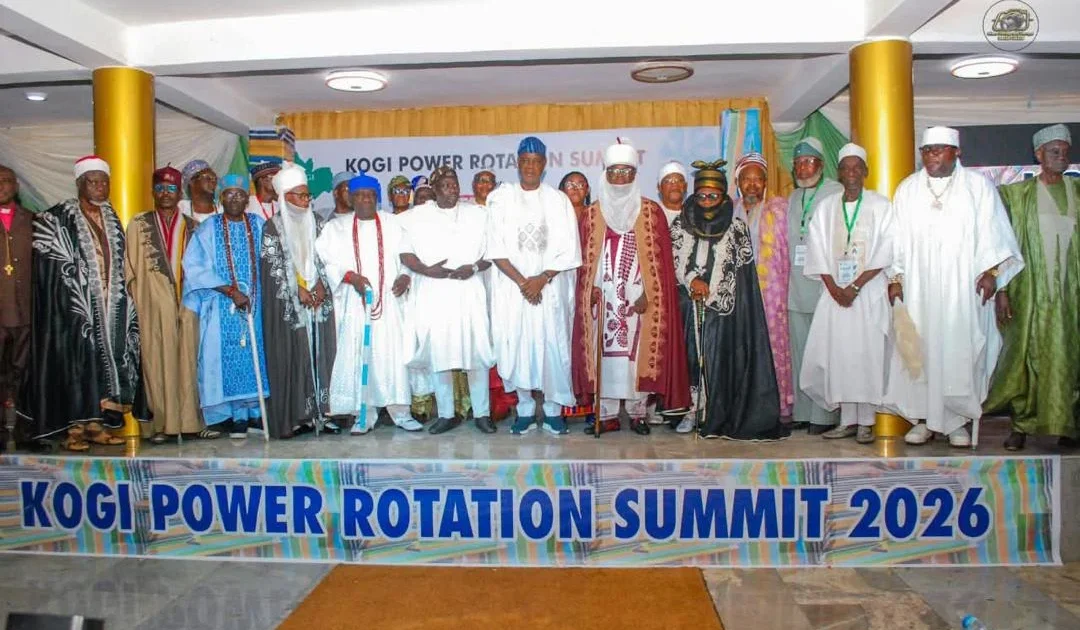
Stakeholders from Kogi State's three senatorial districts have backed an eight-year rotational arrangement for political power, with the majority favouring its commencement in 2032 after the completion of Governor Usman Ododo's second term. This position was contained in a communiqué issued at the end of the maiden Kogi State Power Rotation Summit held in Lokoja. The summit brought together traditional rulers, religious leaders, political stakeholders, and socio-cultural organisations.
The two-day summit, convened by the Kogi Unity Accord, had the theme "Retooling Kogi for Unity, Equity and Shared Prosperity." It recognised power rotation as a possible mechanism for promoting fairness, unity, peaceful coexistence, and a stronger sense of belonging among the people of Kogi State. However, the stakeholders stressed that rotation should not displace considerations of competence, integrity, capacity, accountability, and leadership ability.
The summit recommended the development of a broad-based framework for political inclusion and equitable participation involving the three senatorial districts. It also called for consultations across Kogi East, Kogi Central, and Kogi West before a final position on the proposed arrangement is adopted. Despite the majority position favouring commencement in 2032, some delegates advocated an earlier transfer of power to Kogi West after the expiration of the incumbent governor's tenure.
The President of the Okun Development Association, Rotimi Akenson, argued that Kogi West had not produced a governor since the creation of the state and should be considered in the next phase of political succession. The Christian Association of Nigeria supported an equitable rotational arrangement beginning after the expiration of Ododo's tenure, with political power moving to Kogi West, and also expressed a preference for a Christian governor.
A major development at the summit was the position of the Kogi State House of Assembly, with its Speaker, Aliyu Yusuf, announcing that the legislature was prepared to enact legislation providing a framework for power rotation. The proposed legislation would provide an institutional framework for an issue that has largely been driven by political convention, advocacy, and stakeholder consultations.
Governor Ododo, represented at the summit by Commodore Jerry Omodara, urged stakeholders to pursue political dialogue without compromising the peace of the state. He called on stakeholders to treat Kogi's diversity as a source of strength and promote trust, peace, and inclusive dialogue as the state approaches another electoral cycle. The governor also urged youths to reject political violence and encouraged stakeholders to pursue peaceful engagement and constructive dialogue.
The summit proposed the development of a Kogi Charter of Equity and Inclusion to guide political participation, peaceful engagement, and representation across the state. It also recommended the establishment of a follow-up mechanism, expansion of the Kogi Unity Accord, creation of zonal structures, and further consultations across the three senatorial districts. The stakeholders resolved that minority tribes and communities should be protected from political marginalisation.
Key points
- The proposed power rotation arrangement is expected to commence in 2032.
- The Kogi State House of Assembly is prepared to enact legislation providing a framework for power rotation.
- The summit proposed the development of a Kogi Charter of Equity and Inclusion.