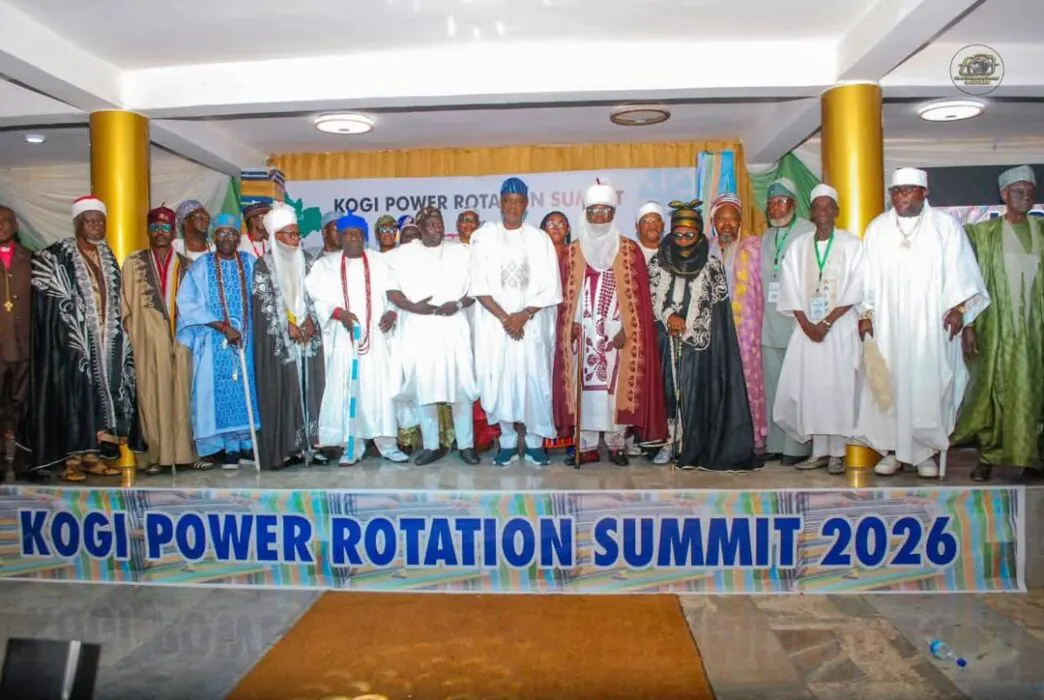
A two-day Kogi Power Rotation Summit held in Lokoja has reached a consensus on an 8-year rotational arrangement for the state's governorship, set to begin in 2032. The summit, organised by the Kogi Unity Accord, brought together stakeholders from across the state, including traditional rulers, religious leaders, and civil society groups. The agreement allows Governor Ahmed Usman Ododo to complete his second term in office. This move aims to promote fairness, unity, and peaceful coexistence among the people of Kogi State.
The summit's communiqué, issued on October 1, 2026, stated that the proposed date of 2032 would allow for further consultations, legislation, and development of a legal framework. However, not all delegates agreed, with some calling for the power to be transferred to Kogi West immediately after Ododo's tenure. The President of the Okun Development Association, Amb. Rotimi Akenson, argued that Kogi West should produce the next governor, citing that the zone has not produced a governor since the state's creation.
The Christian Association of Nigeria (CAN) also supported the transfer of power to Kogi West after Ododo's tenure, expressing a preference for a Christian governor due to ethnic and religious considerations. The summit acknowledged that power rotation could promote a stronger sense of belonging among the people of Kogi State but stressed that rotation should not override considerations of competence, integrity, and leadership ability.
The Kogi State House of Assembly has indicated its willingness to consider legislation providing a framework for power rotation. Speaker Aliyu Umar Yusuf stated that the issue requires careful deliberation and that stakeholders' views will be considered in the legislative process. Governor Ododo, represented by Commodore Jerry Omodara (Rtd.), urged stakeholders to pursue political dialogue without compromising peace in the state.
The summit chairman, Vice Admiral Joseph Ajayi (Rtd.), called for peaceful engagement as the state approaches another electoral cycle. The summit recognised that the 1999 Constitution, as amended, does not expressly provide for rotation of the governorship among senatorial districts. Therefore, any eventual arrangement should comply with constitutional, electoral, and democratic processes.
Governor Ododo's administration has received support from delegates for the proposed power rotation arrangement. The governor was represented by Commodore Jerry Omodara (Rtd.) at the summit. The event brought together a diverse group of stakeholders, including traditional rulers, religious leaders, and civil society groups.
The proposed power rotation arrangement is expected to promote fairness and unity in Kogi State. Key stakeholders have expressed support for the plan, with some calling for its implementation to begin in 2032. The Kogi Unity Accord organised the summit to foster dialogue and agreement among stakeholders on the state's future.
Key points
- The proposed 8-year rotational arrangement for Kogi State's governorship is set to begin in 2032.
- The summit's communiqué allows Governor Ahmed Usman Ododo to complete his second term in office.
- Some delegates called for immediate power transfer to Kogi West after Ododo's tenure, citing regional and religious considerations.