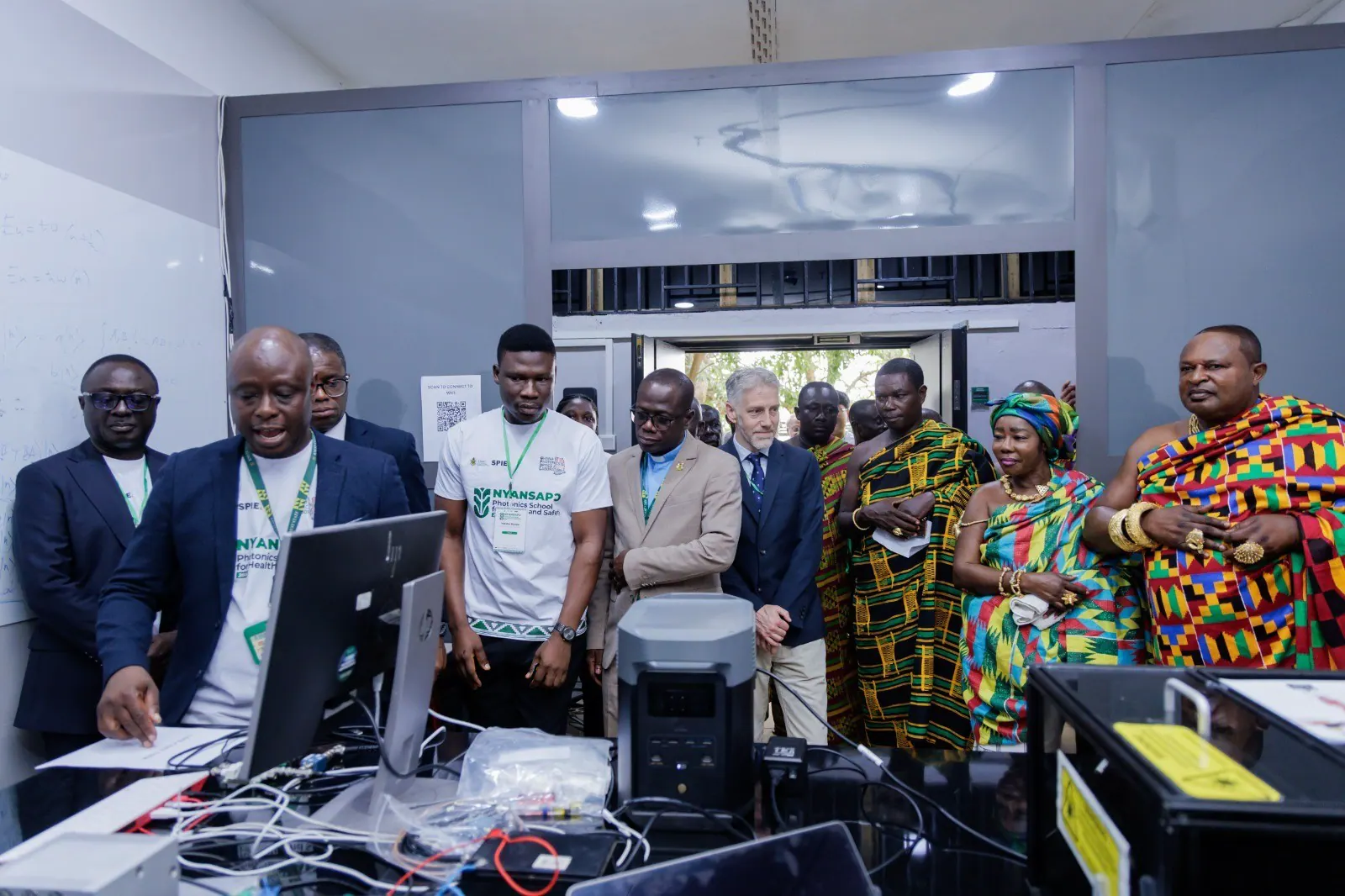
The Kwame Nkrumah University of Science and Technology (KNUST) has officially launched the Ghana Photonics and Optics Laboratory (GPOL), a state-of-the-art facility aimed at advancing research and training in photonics and optics. Located at the Department of Physics, KNUST, the laboratory is the second dedicated optics and photonics lab in Ghana and the first at the university. The GPOL was made possible through research work done by Dr. Akyana Britwum and Dr. Michael Kweku Edem Donkor, with seed funding from SPIE, the International Society for Optics and Photonics.
The laboratory is equipped with teaching and measurement kits, research and community-built instruments, and everyday lab equipment. The vision for the GPOL is to become a center of excellence in photonics and optics, training the next generation of scientists and innovators, and advancing research in the field. According to Professor Philip Antwi-Agyei, Provost of KNUST College of Science, the laboratory will enable Ghana to develop its capacity for photonics, which is crucial for the country's scientific and economic growth.
Professor Antwi-Agyei emphasized that a country that cannot utilize light effectively is forced to rely on others for answers, which is a situation the GPOL aims to change. He noted that the laboratory will foster collaborations across various sciences, including chemistry, biology, medicine, food science, and engineering. The professor highlighted that the GPOL offers tools that allow researchers to ask and answer questions that matter to Ghana.
The launch of the GPOL is significant for Ghana, as it addresses the country's need for self-reliance in scientific measurements. Professor David Asamoah, Pro Vice-Chancellor of KNUST, stated that every decision the country makes about safety and trade rests on measurements, and for a long time, both the instruments and verdicts have come from outside Ghana. He urged government agencies and regulators to make the most of the laboratory.
Dr. Peter de Groot, Chair of the GPOL Advisory Board and the 2025 President of SPIE, noted that the challenge in a rapidly changing world is to overcome barriers, build capacity, and do great science. He emphasized that SPIE is helping to bridge this gap by creating an international capacity-building template and partnering with the right people to build opportunities.
The GPOL launch is part of the NYANSAPƆ Photonics School for Health and Safety, which involves 38 students from six African countries. The school features laboratory sessions, plenary talks, distinguished lectures, and a keynote taught by seventeen invited faculty members from Spain, the United States, the United Kingdom, France, Côte d’Ivoire, and Togo.
The photonics-enabled marketplace was estimated at $2.5 trillion in 2024, according to the SPIE Optics and Photonics Global Industry Report 2025. The GPOL is expected to contribute to Ghana's participation in this growing industry and enhance the country's scientific capacity. Key stakeholders have welcomed the initiative, recognizing its potential to drive economic growth and improve healthcare.
Key points
- The laboratory will enable Ghana to develop its capacity for photonics and become self-reliant in scientific measurements.
- The GPOL aims to become a center of excellence in photonics and optics, training the next generation of scientists and innovators.
- The laboratory will foster collaborations across various sciences, including chemistry, biology, medicine, food science, and engineering.