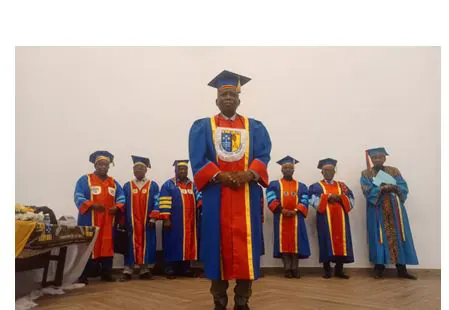
A doctoral thesis defended at the Université pédagogique nationale (UPN) in Kinshasa, Democratic Republic of the Congo, examines the construction of individual, collective, and referential identity in three works by Congolese writer Alain Mabanckou. The thesis, titled around the study of "African Psycho," "Les petits-fils nègres de Vercingétorix," and "Le Sanglot de l'homme noir," employed structural and transcendental semiotics, as well as socio-semiotics.
The researcher, Jean Willy Mutombo, explained that "mêmeté" refers to the recognition of common characteristics, continuity, and harmony, while "ipséité" relates to choices that prioritize singularization, differences, tensions, and conflicts. The study used various tools, including the semiotic square, actantial scheme, generative path, narrative scheme, narrative programs, and pathématic scheme. These tools allowed for an examination of the semantic, actantial, modal, thematic, figurative, and narrative structures of the selected works.
The thesis analyzed individual and collective identities in tension, highlighting masculine and feminine identities. The study found that conflicts in the works reveal personal and communal choices related to ipséité, while the permanence of certain characteristics refers to mêmeté. Collective identity was examined through geographic and racial categorizations, which can be influenced by ideological manipulations. The research also emphasized the importance of common characteristics and belonging to a shared space or category.
The study explored the conception of Negritude in Alain Mabanckou's works, revealing a different orientation than that of Aimé Césaire. Mabanckou's Negritude is characterized as a "Negritude of cut bridges," where the main characters, immigrants in the West, choose to invest in their new homeland. Even when certain works appear to valorize black values, the analysis detected an ironic dimension. The research established a coherence between the identities developed in the three studied works.
The thesis proposed a reconfiguration of the categories of mêmeté and ipséité, extending them beyond personal identity to integrate alterity, the collective, and referential correspondence. The researcher also suggested distinguishing between theme, motif, and topo, and introduced a renovated actantial scheme and additional tools, such as the "triangle of animosity" and the "triangle of the virtuous adjutant."
The study recommended extending research to other works by Alain Mabanckou and conducting comparative studies with other contemporary African writers. This would help analyze the mechanisms by which literary works transform real-life elements into creative materials. After debate and deliberation, the candidate was declared a doctor in French language and civilization with a "great distinction" mention.
The thesis contributes to the scientific community by providing new insights into identity construction in literature. The research has implications for understanding the complexities of individual and collective identities in the context of African literature. The study's findings can inform further research in literary analysis and cultural studies.
Key points
- The thesis examines identity construction in three works by Alain Mabanckou.
- The study proposes a reconfiguration of the categories of mêmeté and ipséité.
- The research recommends extending studies to other works by Mabanckou and other African writers.