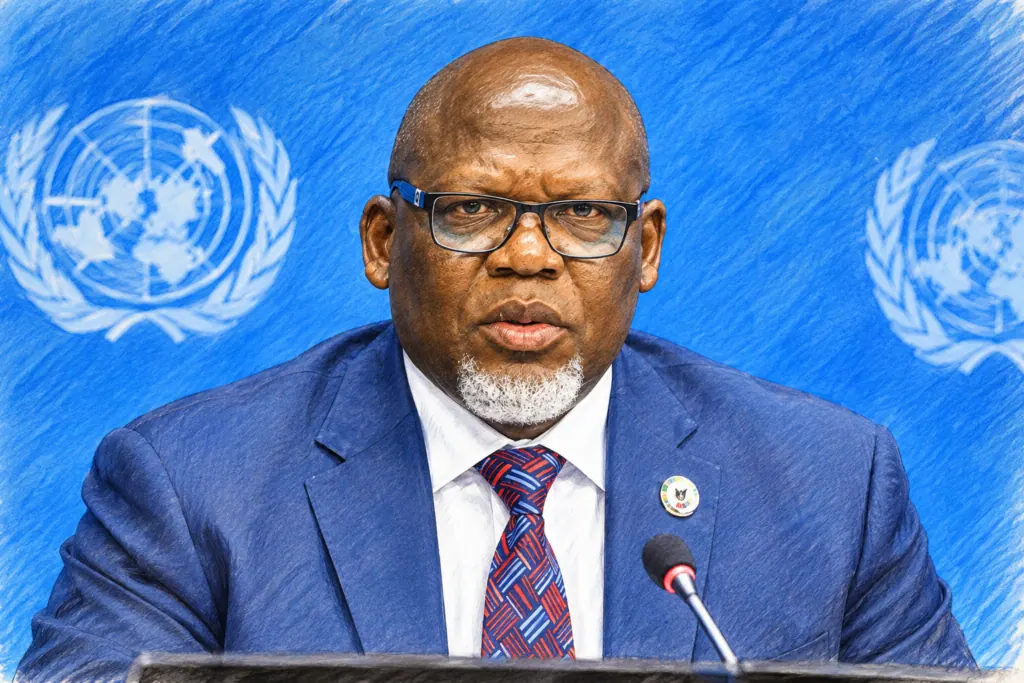
The Democratic Republic of Congo's Permanent Representative to the United Nations, Ambassador Zénon Mukongo Ngay, has sparked controversy with a statement before the UN Security Council. He described the FDLR, a militia group, as "Hutu who were in power before 1994 and fled Rwanda after the Tutsi came to power." This narrative has been criticized for omitting the 1994 Genocide Against the Tutsi, in which over one million people were killed. The FDLR has been linked to individuals responsible for the genocide.
The omission of the genocide in Ambassador Mukongo's statement has been seen as a significant distortion of historical facts. By portraying those who fled Rwanda after 1994 as victims of political persecution, Kinshasa is effectively turning the historical narrative upside down. This framing echoes the FDLR's own political narrative, which has sought to portray Rwanda's post-1994 political order as illegitimate and to cast perpetrators as victims. The UN has extensively documented the 1994 genocide and the FDLR's role in it.
The FDLR cannot be separated from the history of the 1994 genocide, according to the UN. The International Criminal Tribunal for Rwanda subsequently prosecuted individuals responsible for the genocide and other serious crimes. The UN Security Council has repeatedly documented the presence of individuals linked to the 1994 genocide within the FDLR and has treated the organization as an armed group whose activities pose a threat to peace and security in the region.
Kinshasa's narrative has been criticized for giving diplomatic legitimacy to a narrative associated with the FDLR. The similarities between Kinshasa's narrative and the FDLR's political messaging are increasingly difficult to ignore. When a senior Congolese diplomat repeats essentially the same framing before the United Nations, it raises concerns about what this political framing means for Congolese Tutsi communities living in areas such as Minembwe and Masisi.
The denial of the Genocide Against the Tutsi in Rwanda, combined with the alliance between perpetrators of yesterday and those of today, is further evidence that the principle of "Never Again" risks being trampled once more. Former UN adviser on genocide prevention Alice Wairimu Nderitu warned about this. The international community's failure to act could have serious consequences.
Ambassador Mukongo's intervention has been seen as part of a broader political environment in which Kinshasa maintains its alliance with a genocidal militia while portraying Rwanda as the principal source of instability in the region. His visibly unpolished appearance, including his apparent difficulty even buttoning his suit properly, has been seen as an unfortunate visual metaphor for the quality of the representation he delivered.
The controversy surrounding Kinshasa's UN remarks highlights the need for accurate and nuanced discussion of historical events. The international community must be vigilant in preventing genocide denial and the rehabilitation of perpetrators. The UN Security Council must address these issues seriously and ensure that its platform is not used to promote hate speech or genocide ideology.
Key points
- The DRC's UN ambassador omitted the 1994 genocide in his description of the FDLR.
- Kinshasa's narrative has been criticized for giving diplomatic legitimacy to a narrative associated with the FDLR.
- The international community's failure to act could have serious consequences for Congolese Tutsi communities and the prevention of genocide.