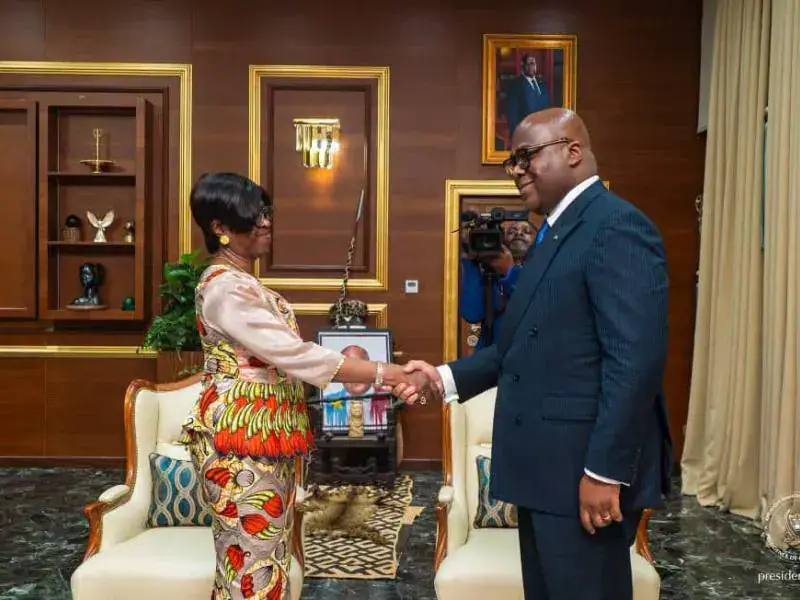
Christian Moleka, a political analyst, has shed light on the Democratic Republic of Congo's strategy in the race for the leadership of the Organisation Internationale de la Francophonie (OIF). According to Moleka, Kinshasa's primary goal is to prevent Rwanda's candidate, Louise Mushikiwabo, from winning, rather than pushing for its own candidate, Juliana Lumumba, to succeed. This stance has significant implications for the upcoming vote in Phnom Penh.
Moleka revealed that Kinshasa had initially hesitated before nominating Juliana Lumumba, the daughter of Patrice Lumumba, as its candidate. He suggested that the government had considered other potential candidates, including Justine Kazadi, Denis Mukwege, and Freddy Matungulu. Moleka noted that Mukwege's lack of ministerial experience put him at a disadvantage compared to other contenders. This has raised questions about the effectiveness of Kinshasa's campaign.
The analyst also discussed the French government's role in the election, stating that Kinshasa had hoped for Paris to support its candidate. However, France has opted for a "third way," backing former Romanian Prime Minister Dacian Cioloș. This move is seen as an attempt to avoid taking sides in the dispute between Kinshasa and Kigali. Moleka believes that this approach may allow the Congo to "not lose face" and avoid escalating tensions.
A victory for Dacian Cioloș would not be a straightforward success for Kinshasa, according to Moleka. While it would be a setback for Rwanda, it would also mean that Kinshasa's preferred candidate did not win. Moleka described this outcome as "a half-victory, a half-defeat." The analyst emphasized that the Congo's primary goal is to prevent Mushikiwabo from winning, rather than ensuring Lumumba's success.
The threat of the Congo's withdrawal from the OIF has been raised, but Moleka believes this is a negotiating tactic rather than a genuine possibility. He pointed to the historical context of tensions between the Congo and the OIF, particularly regarding the organization's response to the conflict with Rwanda. Moleka suggested that the Congo's weight in the francophone world, both demographically and economically, makes it a crucial player.
Moleka highlighted the divisions within Africa, which have hindered a unified continental approach to the OIF leadership election. He cited the multiplicity of African candidatures and the late emergence of some candidates, including former Senegalese President Macky Sall. The analyst warned that the conflict between the Congo and Rwanda is expanding into new areas, including diplomacy and economics.
The OIF leadership election has significant implications for the Congo and the wider region. Moleka emphasized that the Congo's influence in the francophone world is substantial, but it still needs to translate this potential into effective leverage. The outcome of the election will be closely watched, as it may set a precedent for future international diplomatic battles.
Key points
- The Congo's primary goal in the OIF leadership election is to prevent Rwanda's candidate, Louise Mushikiwabo, from winning.
- Kinshasa had initially hesitated before nominating Juliana Lumumba as its candidate.
- The French government's backing of a "third way" candidate, Dacian Cioloș, may help to diffuse tensions between Kinshasa and Kigali.