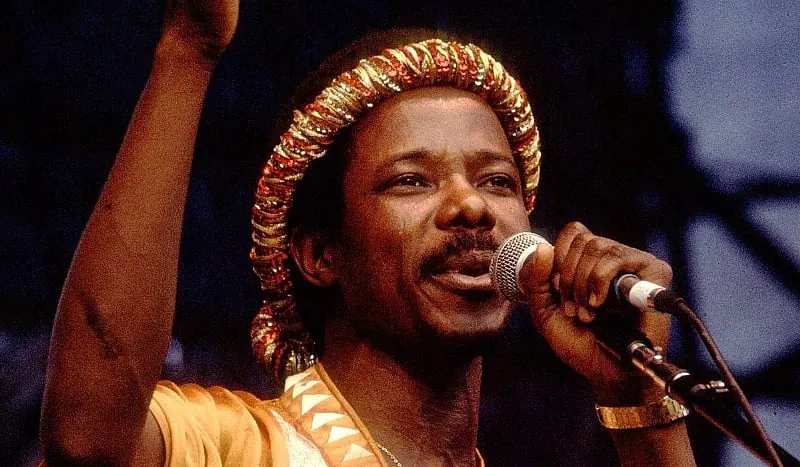
Nigerian musician King Sunny Adé, born Sunday Adeniyi Adegeye, is celebrating his 80th birthday. With a career spanning over 60 years, he has significantly influenced Nigeria's popular music scene, particularly in promoting jùjú music. Jùjú is a Nigerian musical tradition that combines intricate rhythms, percussion, guitars, talking drums, call-and-response, and Yoruba oral culture. Adé's music not only entertains but also expresses cultural identity, transmits proverbs and praise traditions, and comments on social life.
King Sunny Adé was born on September 22, 1946, in Òṣogbo, a town renowned as a center of arts, music, and culture in south-west Nigeria. His early life immersed him in both religious and traditional music settings, with his father being a church organist and his mother a trader. Adé's attraction to music led him to attend St Charles Grammar School, Òṣogbo, and later move to Lagos, where he gained experience as a guitarist and percussionist. He collaborated with renowned musicians, including Moses Olaiya Adejumo's Federal Rhythm Dandies.
Adé's career took a decisive turn in the 1960s when he established his own group, the Green Spots, in 1967. Having his own band allowed him to develop a distinct musical identity, and his recordings quickly established him as an important figure in Nigerian jùjú. He established his own record label, Sunny Alade Records, in the mid-1970s, giving him greater control over his recordings and career. His popularity extended beyond Nigeria through tours, including performances in Britain, with his first performance in the UK in 1975.
In 1982, Adé signed with Island Records, and the release of the album Juju Music introduced his distinctive sound to a wider audience. The album was followed by Synchro System in 1983 and Aura in 1984. Synchro System earned a Grammy nomination in 1983, the first for a Nigerian artist. Although his relationship with Island Records ended in 1985, the international exposure he gained changed the perception of popular African music worldwide.
Adé's most significant artistic achievement is the evolution and global expansion of modern jùjú music. He maintained traditional elements and incorporated new instruments, arrangements, and production methods. His music integrated electric guitars, talking drums, pedal-steel guitar, synthesizers, and other instruments, producing a sound that was both contemporary and classic. His live performances were known for their energy and duration, often lasting for hours.
King Sunny Adé's impact extends beyond his music to his dedication to nurturing musical institutions and younger generations. He established the King Sunny Ade Foundation, which provides resources for music, performance, and young musicians. He has also made a notable impact in Nigeria's music industry by participating in copyright advocacy and the Musical Copyright Society of Nigeria.
As King Sunny Adé celebrates his 80th birthday, he remains a renowned musician and cultural ambassador, with a legacy that continues to inspire and influence new generations of musicians. His music has linked Yoruba traditions with worldwide popular culture, showing that African artists can engage in global music without compromising their cultural identity.
Key points
- King Sunny Adé has maintained his cultural roots while innovating and expanding the reach of jùjú music globally.
- He has received multiple accolades, including Grammy nominations for his albums Synchro System and Odu.
- Adé's legacy extends beyond music to his contributions to Nigerian cultural preservation and the development of young musicians.