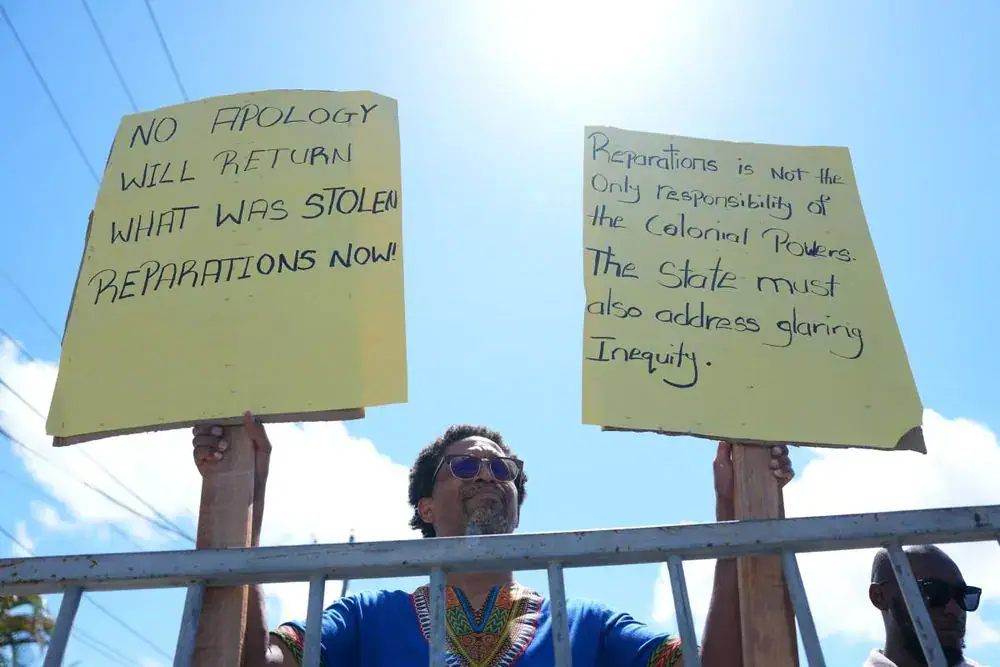
British King Charles III addressed the Commonwealth Heads of Government Meeting in Antigua and Barbuda, describing the transatlantic slave trade as a "shameful chapter of history" that fills his heart with horror and his soul with "the most profound personal sorrow". However, his expression of regret did not include an apology, a stance that has been met with criticism from various quarters. The King's remarks reflect a long-standing refusal to face the implications of Britain's historical responsibility for the slave trade.
The British monarchy's connection to the slave trade is well-documented. In 1672, King Charles II granted the Royal African Company a monopoly over the English slave trade, and royal charters were granted to companies that profited from slavery. Although the monarch cannot commit public funds or determine government policy, the issue of institutional accountability remains. Prime Minister Andy Burnham's willingness to discuss a formal apology, while ruling out financial reparations, raises questions about the Crown's failure to issue an apology.
Other countries have taken steps to acknowledge and make amends for their roles in the slave trade. The Netherlands government apologized for its role in 2022 and set up a €200 million fund, followed by the Dutch King's apology a year later. Both acknowledged that history carries obligations. In contrast, Britain's response has been limited to expressions of regret, without taking concrete actions or offering compensation.
The legacy of the transatlantic slave trade continues to have a profound impact on the Caribbean and other parts of the Commonwealth. Between the 15th and 19th centuries, close to 12.5 million Africans were abducted and sold into slavery, with Britain transporting close to 3.2 million of them. The survivors endured forced labor, sexual abuse, and the systematic denial of their humanity, while the profits fueled European industrialization and destabilized African societies.
The Caribbean Community (CARICOM) has pushed for reparations to be placed on the CHOGM agenda, but the King's pledge of a "modern partnership to address the wrongs of the past" through education, jobs, and climate resilience falls short of their demands. CARICOM's Ten-Point Plan for Reparatory Justice insists on a formal apology, debt cancellation, educational and health investment, cultural restitution, and development support.
The issue of reparations is also being pursued through legal channels. In September 2026, Jamaica petitioned King Charles, as King of Jamaica, to refer three questions to the Judicial Committee of the Privy Council, including whether enslaving Africans was ever lawful under English law and whether Britain owes a reparatory remedy. A preliminary hearing is expected in March 2027, and a Privy Council finding could have significant implications for Britain's stance on historical injustices.
The debate over reparations and apologies for historical injustices is likely to continue, with the African Union, SADC, and other regional bodies urged to align with CARICOM's demands. The Commonwealth cannot present itself as a partnership of equals while historical crimes continue to stain its contemporary fabric. Britain's reluctance to acknowledge its role in the slave trade and offer concrete reparations has been consistent, and it remains to be seen whether the country will move beyond expressions of regret to take meaningful action.
Key points
- The British monarchy's connection to the slave trade is well-documented, with King Charles II granting the Royal African Company a monopoly over the English slave trade in 1672.
- The legacy of the transatlantic slave trade continues to have a profound impact on the Caribbean and other parts of the Commonwealth, with millions of Africans abducted and sold into slavery.
- The debate over reparations and apologies for historical injustices is likely to continue, with the African Union, SADC, and other regional bodies urged to align with CARICOM's demands.
Reporting sources
- Royal remorse won't settle slavery's unpaid debt · Pretoria News