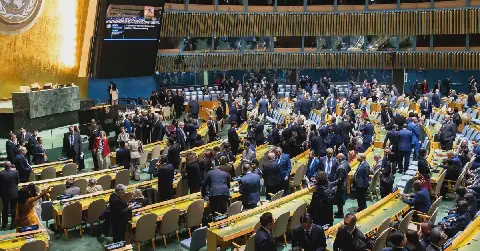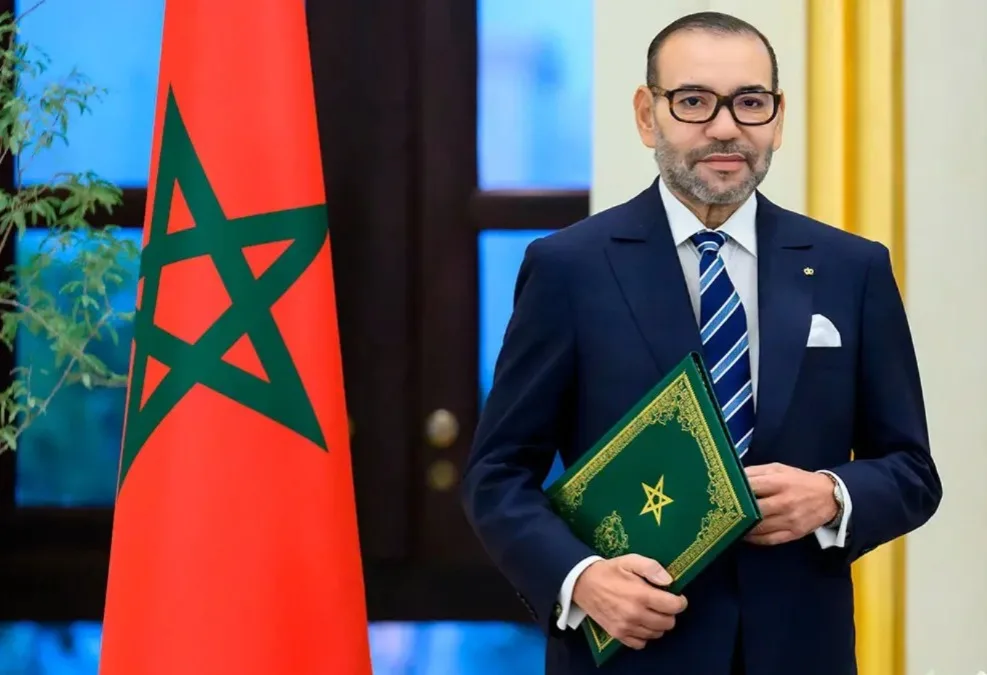
On September 22, 2026, Moroccan Foreign Minister Nasser Bourita addressed the United Nations General Assembly, invoking King Mohammed VI's assessment of a rapidly transforming world where certainty is receding and international law faces repeated violations. This reference established the political framework for Bourita's message, emphasizing that countries cannot safeguard their security by merely containing crises or awaiting negotiated settlements.
Bourita's address highlighted the interconnectedness of various global challenges, including armed groups, climate change, Palestine, Africa, and the Moroccan Sahara. He stressed that these issues are not separate but different dimensions of a common challenge involving the protection of sovereignty, the development of resilient institutions, and Morocco's capacity to contribute to regional stability while defending its national interests.
A key aspect of Bourita's message was holding sponsors of armed groups accountable, shifting attention from the activities of these organizations to the conditions enabling their survival. He warned about threats to maritime passages, straits, and critical infrastructure, illustrating why armed groups can no longer be treated solely as domestic security concerns. This position has significant implications for Morocco's security and regional stability.
On Palestine, Bourita reaffirmed Morocco's support for an independent Palestinian state with East Jerusalem as its capital, respect for the ceasefire, and unhindered humanitarian assistance. He also highlighted Morocco's participation in the International Stabilization Force for Gaza, authorized by the UN Security Council through Resolution 2803 in November 2025. The challenge is to help restore Palestinian institutions' capacity to provide security and essential services.
In Africa, King Mohammed VI's initiative to provide Sahel countries with Atlantic access, the Atlantic African States Initiative, and the African Atlantic Gas Pipeline aim to expand economic opportunities for countries whose geographical isolation compounds existing vulnerabilities. These projects offer a framework for regional integration, combining economic cooperation with security efforts.
The Moroccan position on the Moroccan Sahara, outlined by Bourita, carries particular significance ahead of the next Security Council discussions. He outlined six principles defining Morocco's position, including autonomy under Moroccan sovereignty, UN-sponsored negotiations, and rejection of both the continued status quo and ceasefire violations. The resolution establishes Morocco's Autonomy Proposal as the basis for negotiations.
Morocco's approach to global crises, as outlined by Bourita, emphasizes the importance of accountability, institution-building, and development in addressing the root causes of instability. The country's participation in international efforts, such as the International Stabilization Force for Gaza, and its initiatives in Africa, demonstrate its commitment to contributing to regional stability and defending its national interests.
Key points
- Morocco's Foreign Minister Nasser Bourita emphasizes holding sponsors of armed groups accountable.
- King Mohammed VI's initiative aims to provide Sahel countries with Atlantic access.
- Morocco's position on the Moroccan Sahara is defined by six principles, including autonomy under Moroccan sovereignty.