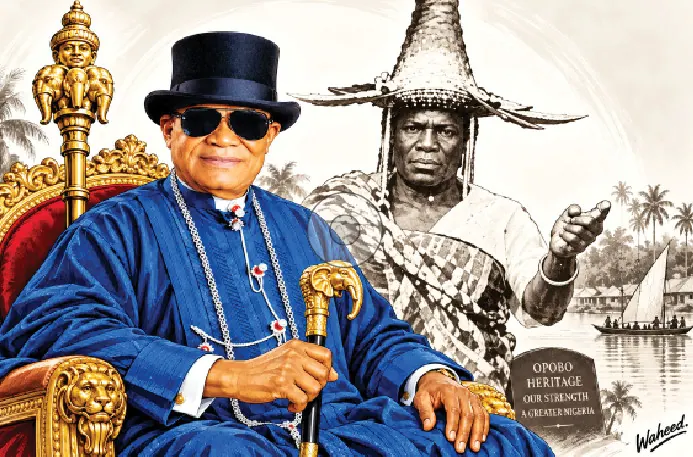
The life and achievements of King Jaja of Opobo offer valuable lessons for modern-day Nigeria as the country navigates diplomatic pressure, economic uncertainty, and deepening social tension. More than a century after Jaja's rise to power, his story remains relevant to Nigeria's ongoing struggles with resources, economic independence, leadership, and institution-building. As the Opobo Kingdom prepares for the coronation of His Majesty, King Charles Douglas MacPepple Jaja, Jeki VI, as Amanyanabo and Treaty King on September 26, 2026, Jaja's legacy continues to inspire reflection and action.
King Jaja's remarkable achievement was not only his rise from adversity to become a powerful king and merchant but also his understanding of the architecture of power. He recognised that control over access to the hinterland, trading channels, terms of exchange, and relationships with foreign merchants was crucial to accumulating wealth and leverage. From Opobo, Jaja built a formidable commercial and political order, organising people, securing routes, cultivating alliances, and resisting European attempts to bypass African middlemen and dictate commercial terms.
Jaja's struggle was not against trade with the outside world but against the erosion of African autonomy and agency. He insisted that engagement with external partners must not become surrender and that partnership must not deprive a people of the right to defend their interests. This nuanced approach to international engagement is particularly relevant for modern Nigeria, which must balance its economic needs with the imperative of maintaining sovereignty and economic agency.
The commodities that drive Nigeria's economy have changed since Jaja's time, but the questions remain the same. Who sets the terms on which Nigerian resources enter the world economy? Who owns the technology, finances production, processes raw materials, and controls distribution? Who captures the value, and how much remains in Nigerian hands? These questions highlight the need for Nigeria to move beyond mere possession of resources to exercising control over the value chain.
Nigeria has often mistaken possession for power, but producing crude oil, growing cocoa, or extracting minerals is not the same as controlling the petroleum value chain, processing, packaging, branding, and distributing products. Deposits of lithium, gold, or iron ore do not guarantee prosperity without the necessary knowledge, capital, infrastructure, and institutions to organise around them. Jaja understood this distinction in the nineteenth century; Nigeria still wrestles with it in the twenty-first.
The consequences of Nigeria's failure to retain value from its resources are evident in its economic performance. The country exports too many raw materials and talented people, then imports finished goods, technology, and expertise at a premium. This pattern of trade has resulted in a large market that mainly consumes what others produce, rather than an economic power that captures value from its resources. Economic self-determination does not mean isolation or hostility to investment but rather engaging with external partners on terms that respect Nigerian autonomy and agency.
As Nigeria reflects on King Jaja's legacy, the nation is faced with a choice: to continue down a path of economic dependency or to pursue sovereignty and economic agency with strategic audacity. The coronation of King Charles Douglas MacPepple Jaja, Jeki VI, as Amanyanabo and Treaty King serves as a reminder of the enduring relevance of Jaja's example and the need for Nigeria to convert its abundance into prosperity.
Key points
- King Jaja's legacy serves as a call to action for Nigeria to pursue economic self-determination and sovereignty.
- Nigeria must move beyond mere possession of resources to exercising control over the value chain.
- Economic self-determination does not mean isolation or hostility to investment but rather engaging with external partners on terms that respect Nigerian autonomy and agency.