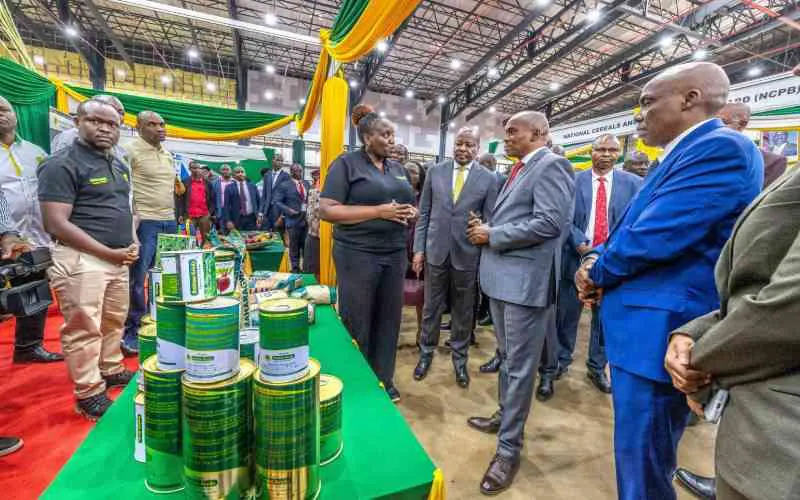
Deputy President Kithure Kindiki has challenged Kenyan farmers to adopt smart agriculture technology to increase productivity and competitiveness in the sector. Speaking at the Agriculture and Food Security Transformation Summit in Nairobi, Kindiki emphasized the importance of technology in improving yields while reducing wastage and production costs. He cited the increasing use of drones and other technologies in precision farming as an example of the future of agriculture.
Kindiki highlighted the government's efforts to transform the agriculture sector through technology and innovation. He mentioned that the government had upgraded the register of farmers from 300,000 to 7.2 million crop farmers and 3 million livestock keepers, providing a foundation for better targeting of government interventions. This expansion enables the government to provide more effective support to farmers.
The Deputy President also emphasized the need for farmers to move away from blanket application of inputs and instead use technology to determine exactly where fertilizer and pesticides are needed. He noted that precision farming is the next frontier of agriculture, allowing farmers to apply the right quantities of inputs and reduce waste. This approach can help increase yields and reduce production costs.
Kindiki highlighted measures aimed at lowering production costs for farmers, including a subsidy programme that has reduced the price of a 50-kilogramme bag of fertilizer from Sh7,000 to Sh2,000. He also mentioned that certified maize seed prices had fallen by half, from Sh300 to Sh150 per kilogramme, while the cost of sexed semen used in artificial insemination of dairy cows had dropped significantly from Sh8,000 to Sh1,400 per dose.
The government has also made significant investments in animal health interventions, with 8.9 million cattle already vaccinated under an ongoing programme targeting the country's estimated 22 million cattle and 50 million small livestock. Kindiki noted that these measures are beginning to translate into increased production and earnings across various agricultural value chains.
Kenya has made significant progress in the dairy sector, emerging as Africa's leading exporter of processed milk. National milk production has risen from 4.6 billion litres to 5.2 billion litres, while the value of dairy exports has increased from Sh4.9 billion to Sh8.9 billion. Meat exports have also risen from Sh8.9 billion to Sh12.9 billion, demonstrating the positive impact of government interventions.
The government is also investing in agro-processing and value addition, with 17 County Aggregation and Industrial Parks completed and being equipped to support processing. Kindiki emphasized that the farmer is at the centre of this transformation, and their work is critical to Kenya's food security and economic future. The government's efforts aim to support farmers and increase their earnings from their produce.
Key points
- The Kenyan government is promoting smart agriculture technology to increase productivity and competitiveness in the sector.
- The government has made significant investments in animal health interventions, including vaccination programmes for cattle and small livestock.
- Kenya has made significant progress in the dairy sector, emerging as Africa's leading exporter of processed milk.