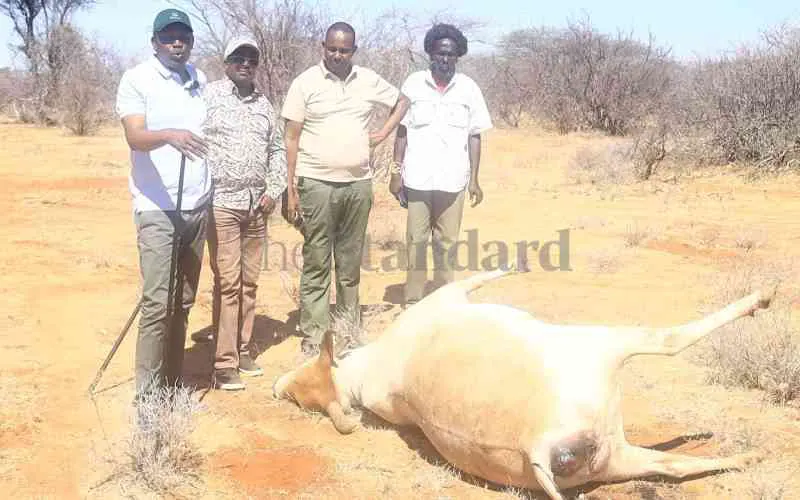
A recent security operation in Waso Ward, Samburu East, has sparked controversy over the killing of livestock, raising concerns about collective punishment of innocent residents and animals. The operation, which began on September 19, was aimed at recovering stolen livestock and removing illegal firearms from the area. However, residents reported that instead of recovering stolen animals and arresting bandits, the security forces killed hundreds of livestock. The incident has forced a hard constitutional question: When does legitimate security become collective punishment of the innocent?
The security operation was a response to a series of attacks along the Samburu-Isiolo border, including an attack in Gotu where bandits killed two Anti-Stock Theft Unit officers, a police reservist, and two civilians, and stole police firearms. A multi-agency team of GSU and ASTU was deployed to Samburu East to recover stolen livestock and remove illegal firearms. However, the operation has been criticized for its heavy-handed approach, with residents reporting that 415 goats and 102 cattle were shot dead at Losesia and Nolng'erdeed between September 19 and 21.
The killing of livestock has had a devastating impact on the local community, with many residents relying on their animals for food security, school fees, and hospital bills. Samburu East MP Jackson Lekumontare put the figure of killed animals higher at more than 700 goats, 500 cattle, and several donkeys, a figure yet to be independently verified. The incident has raised serious constitutional concerns, with Article 40 protecting the right to property and Article 28 protecting human dignity.
The principle of proportionality under the National Police Service Act requires that force be lawful, necessary, and not excessive. However, the killing of 517 verified animals, with no bandits reported arrested and no stolen animals reported recovered, has raised questions about the proportionality of the operation. The Prevention of Cruelty to Animals Act, Cap 360, and the Animal Welfare and Protection Act, 2023, also criminalize causing unnecessary suffering to animals.
The operation has also reflected failure on four core principles of governance: participation, accountability, effectiveness, and leadership. The community was not involved in the operation, with Lelelit supporting the operation in principle but criticizing its execution. Residents have petitioned the National Assembly to summon Inspector General Douglas Kanja to explain the authorization, command structure, and rules of engagement.
Interior Cabinet Secretary Kipchumba Murkomen has directed agencies to exercise greater caution and distinguish between armed criminals and innocent residents. The directive is an institutional admission that something went wrong. The incident has highlighted the need for a more nuanced approach to security operations, one that balances the need to maintain law and order with the need to protect human rights and animal welfare.
The incident has also highlighted the need for transformational leadership that relies on trust, intelligence, and community networks to target actual criminals. The North Rift region has been affected by banditry for over a decade, with leaders from Meru telling Parliament that they lost close to 20,000 cattle and 300 people to bandits from Isiolo and Samburu in five years. A more effective approach to security would involve community partnership and intelligence-led operations.
Key points
- The security operation in Waso Ward, Samburu East, has raised concerns over collective punishment of innocent residents and animals.
- The killing of livestock has had a devastating impact on the local community, with many residents relying on their animals for food security, school fees, and hospital bills.
- The incident has highlighted the need for a more nuanced approach to security operations, one that balances the need to maintain law and order with the need to protect human rights and animal welfare.