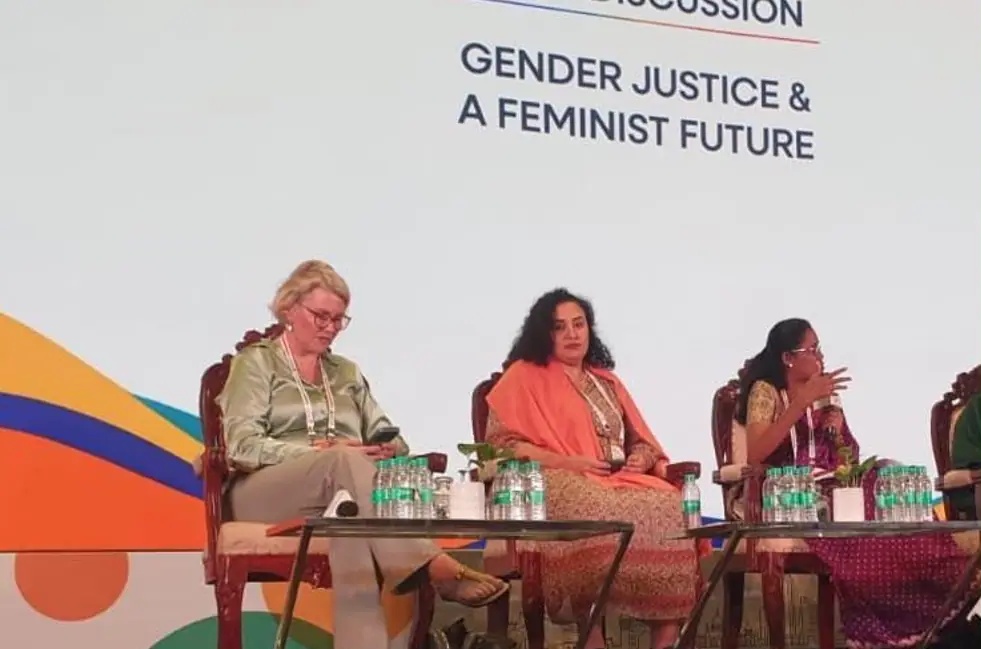
Khaoula Lachguar, Secretary General of the USFP's International Relations, delivered a keynote speech at the BHARAT Summit in Hyderabad, India, on the topic of "La justice entre genres et l’avenir des femmes" (Gender Justice and the Future of Women). She was joined by prominent figures such as Katherine Arnold, Renuka Chowdhury, and Ntombikayise Sibidla. Lachguar focused on the case of Morocco, highlighting the country's legislative advancements in women's rights, despite which it has not seen the expected economic benefits.
Morocco has made significant progress in women's rights, including a notable decrease in maternal mortality rates from 332 per 100,000 births in 1992 to 72.6 in 2018. The country has also seen a high rate of contraception use, with over 70% of women using some form of birth control. Additionally, Morocco adopted the Moudawana in 2004, which reformed family law, and its 2011 Constitution enshrines equality and the supremacy of international conventions. The country has also implemented legislation to combat violence against women.
Despite these advancements, Lachguar pointed out a significant paradox: while Morocco has implemented progressive laws, the country's female labor market participation rate has decreased from 28.1% in 2000 to 18.1% today. According to the Haut-Commissariat au Plan, this decline is a pressing issue that needs to be addressed. Lachguar emphasized that Morocco's problem is not a lack of legislation, but rather the failure to translate these laws into tangible economic benefits for women.
Lachguar highlighted that women in Morocco have shifted from formal employment to unpaid work, citing a national survey on time use. The survey revealed that women dedicate five hours a day to domestic tasks and childcare, compared to just 43 minutes for men. This unpaid work accounts for 87% of women's activities and is valued at 34.5% of Morocco's GDP. However, this work is not officially recognized, and women do not receive a salary, social benefits, or pension rights.
The USFP representative also emphasized that focusing solely on women's political representation overlooks the deeper institutional structures that determine their economic fate. She criticized the social protection system, which is based on a male model with a linear career path, penalizing women's fragmented career trajectories. Lachguar also noted that the family remains a crucial space where women's freedom of movement is determined, and that excessive financial dependence can render existing laws unenforceable in everyday life.
Lachguar discussed Morocco's tax policy, which taxes individuals separately without considering the household as a whole. This approach, while theoretically sound, penalizes households with working women, as they must bear the costs of childcare, transportation, and domestic help without any tax relief. Furthermore, the tax system only recognizes the wife as a "dependent" if she does not work, creating a fiscal disadvantage for working women.
To address these issues, Lachguar proposed a radical shift in perspective: recognizing childcare and support structures as essential infrastructure for the country's development, rather than just social expenses. She made four concrete recommendations, including regularly measuring unpaid work, evaluating care work using the same methods as large infrastructure projects, and financing support structures as productive investments. By adopting this approach, Morocco can work towards creating a more equitable and supportive environment for women's economic empowerment.
Key points
- Khaoula Lachguar emphasizes that Morocco's problem is not a lack of legislation, but rather the failure to translate these laws into tangible economic benefits for women.
- Women in Morocco dedicate five hours a day to domestic tasks and childcare, compared to just 43 minutes for men, accounting for 87% of women's activities and 34.5% of Morocco's GDP.
- Lachguar proposes recognizing childcare and support structures as essential infrastructure for the country's development, rather than just social expenses.