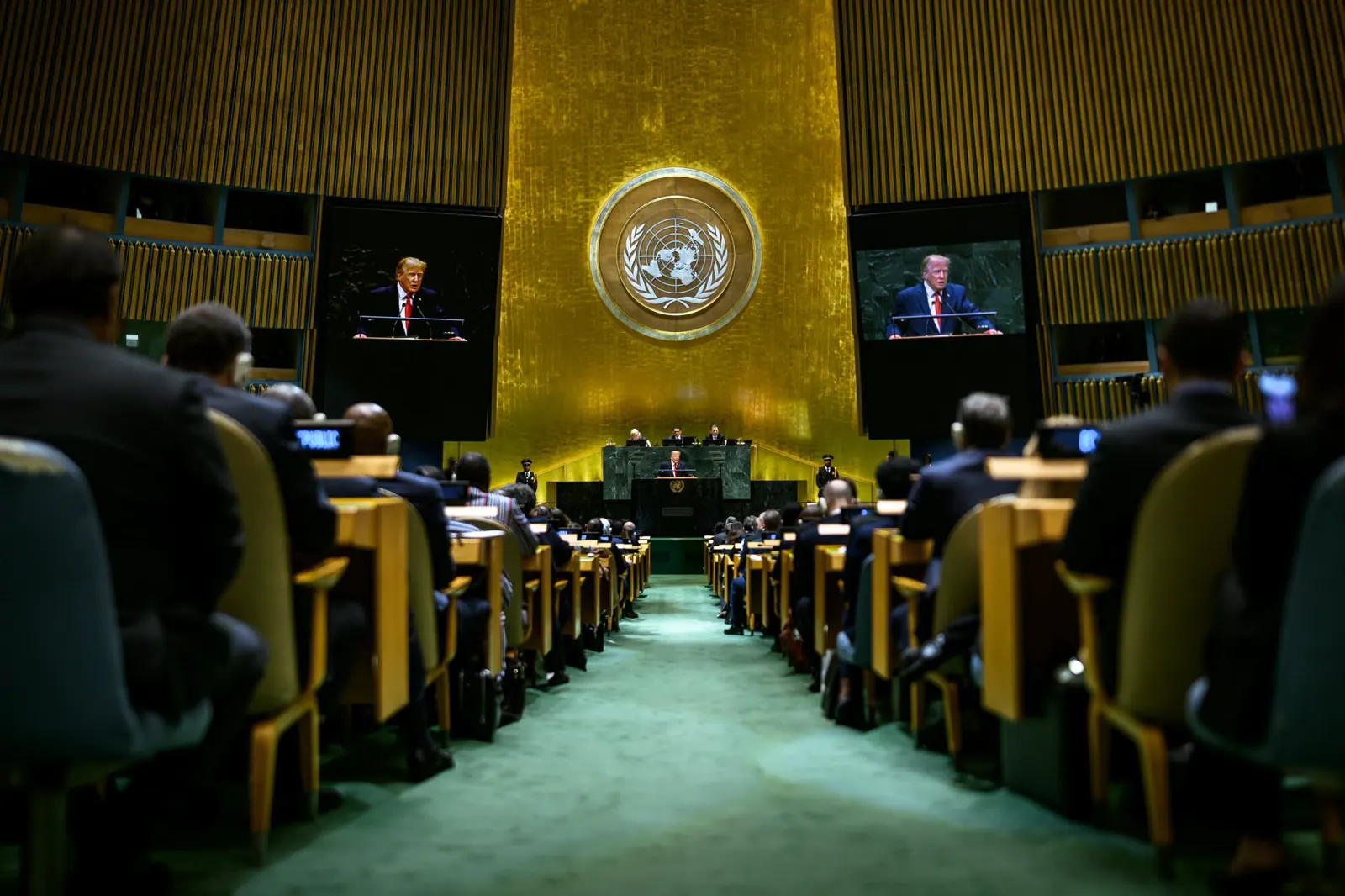
US President Donald Trump addressed the UN General Assembly on Tuesday, delivering a 35-37 minute speech covering various international conflicts, the global economy, migration, artificial intelligence, and US foreign policy. He applauded some of the US's questionable policies and actions, including the war in Iran and sanctions on Cuba. Trump's statements were met with controversy and public attention. His speech signaled further attacks on civilians and civilian infrastructure in Iran.
One of the concerning statements made by Trump was the threat to "annihilate" Iran and "drive them into hell" if the Iranian government did not capitulate and make a deal. This is the latest in a series of threats by the US President that often suggest the destruction of the entire state. Iran has described the threats as a sign of "strategic desperation." A UN mission recently found that the US committed war crimes in Iran. Trump's statement explicitly extends beyond Iran's military leadership or nuclear facilities.
Trump also criticized the UN, an organization built on multilateralism, for becoming too bureaucratic and influenced by "globalist bureaucrats." He praised UN budget cuts and staff reduction under his administration, which led to the elimination of more than 4,000 positions. The US helped cut the UN budget by 15 percent in 2026 under the UN80 reform initiative. This move came amid serious financial pressure partly caused by funding cuts and delayed payments from the US under Trump's 'America First' foreign policy.
A significant portion of Trump's speech focused on artificial intelligence (AI), which he argued should be called "superintelligence." He claimed that the use of the word artificial makes intelligence fake. Trump said technological leadership would be central to economic and geopolitical competition in the years ahead. He also criticized the UN Human Rights Council and UNESCO, accusing them of focusing too much on the US and promoting "mass migration and actively destroying the greatest cultures."
Trump called the International Criminal Court a rogue institution and its members an "evil group of people." He asked all ICC members to resign. Trump's opposition to the organization is due to the arrest warrant issued for his ally, Israeli Prime Minister Benjamin Netanyahu, over Israel's campaign in Gaza. The US has imposed several sanctions on the ICC and its officials since 2025 and has announced plans to impose further sanctions on the court.
Trump framed his approach to foreign policy over his first two years in office as deploying American power to solve "decades of intractable challenges." He bragged about solving issues previous US leaders failed to address. However, some of his claims were found to be false, including his assertion that he ended the war in Gaza. The Gaza Ministry of Health estimated that at least 1,402 Palestinians have been killed and 4,881 others injured in Gaza since Trump's ceasefire due to continuous Israeli attacks.
Trump also discussed Cuba, which has been under US sanctions for over 60 years. He called Cuba a failed state and said that his administration is seeking a fundamental change in the situation in Cuba. Trump defended US action in Venezuela as proof that his administration would not allow any external influence to gain a foothold in the Americas. He announced a major oil agreement between the US and Venezuela, while not providing further details.
Key points
- Trump's speech was marked by controversy, with threats against Iran and criticism of the UN.
- Trump's claims on foreign policy achievements were found to be false, including his assertion that he ended the war in Gaza.
- Trump's speech signaled further attacks on civilians and civilian infrastructure in Iran and continued US pressure on Cuba.