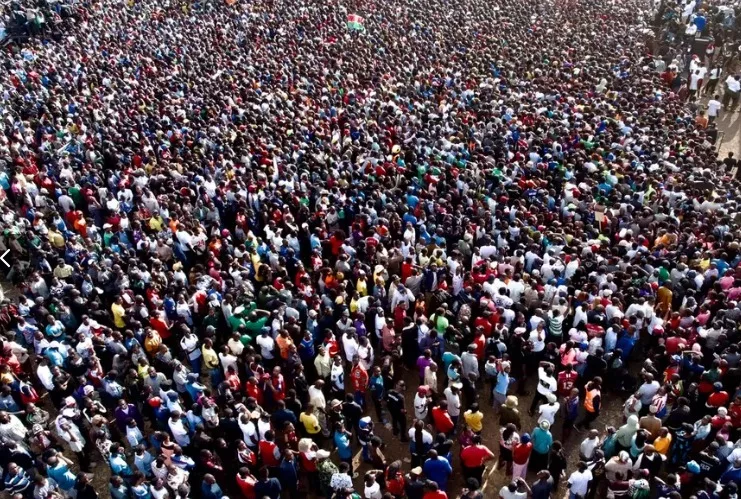
A recent survey conducted by Politrack Research Team has found that Kenyans are almost evenly divided over the direction of the country. The survey, which was conducted between September 15 and 25, 2026, found that 45.2 per cent of respondents believe the country is moving in the right direction, while 44.6 per cent think it is headed down the wrong path. This represents a narrow 0.6 percentage-point gap between those with a positive view and those with a negative view.
The survey also found that a significant section of the population remains undecided on the country's overall trajectory. A total of 10.2 per cent of respondents said they were not sure about the direction Kenya is taking. The survey targeted potential voters across the country and collected data through a text-based technology platform, with 20,419 respondents participating. The results have a confidence level of 95 per cent and a margin of error of +/-3 percentage points.
The Politrack survey assessed public views on the performance of different sectors of government, with housing and roads emerging as areas where the government has performed well. Housing and roads each received 16.3 per cent of the votes when respondents were asked to identify areas where they believed the government had performed well. Health services, including the Social Health Insurance Fund (SHIF) and the Social Health Authority (SHA), followed with 13.0 per cent, while agriculture was cited by 10.0 per cent.
However, health services and the management of SHIF/SHA also emerged among the areas attracting the strongest criticism. According to the poll, 18.4 per cent of respondents identified health services and SHIF/SHA management among areas where the government had performed poorly. The fight against corruption attracted the highest criticism, at 19.2 per cent, while the economy and cost of living recorded 12.0 per cent.
The findings of the survey point to a mixed assessment of the government's record. Infrastructure and housing received relatively positive mentions, while corruption, healthcare, and economic pressures remain major sources of public dissatisfaction. The survey's results suggest that the government still has a lot of work to do to address the concerns of its citizens.
The survey's methodology involved collecting data through a text-based technology platform, allowing sampled users to participate and respond to questions at their convenience. This approach allowed for a large sample size and a high level of accuracy in the results. The survey's findings are likely to be taken seriously by policymakers and other stakeholders.
The results of the survey come as Kenya prepares for the 2027 general election, which is scheduled to take place in 312 days, 15 hours, and 1 minute. The election is likely to be a major test of the government's popularity and could have significant implications for the country's future. Key issues such as corruption, healthcare, and economic pressures are likely to feature prominently in the election campaign.
Key points
- Kenyans are almost evenly divided over the country's direction.
- Housing and roads are seen as areas where the government has performed well.
- Corruption, healthcare, and economic pressures remain major sources of public dissatisfaction.