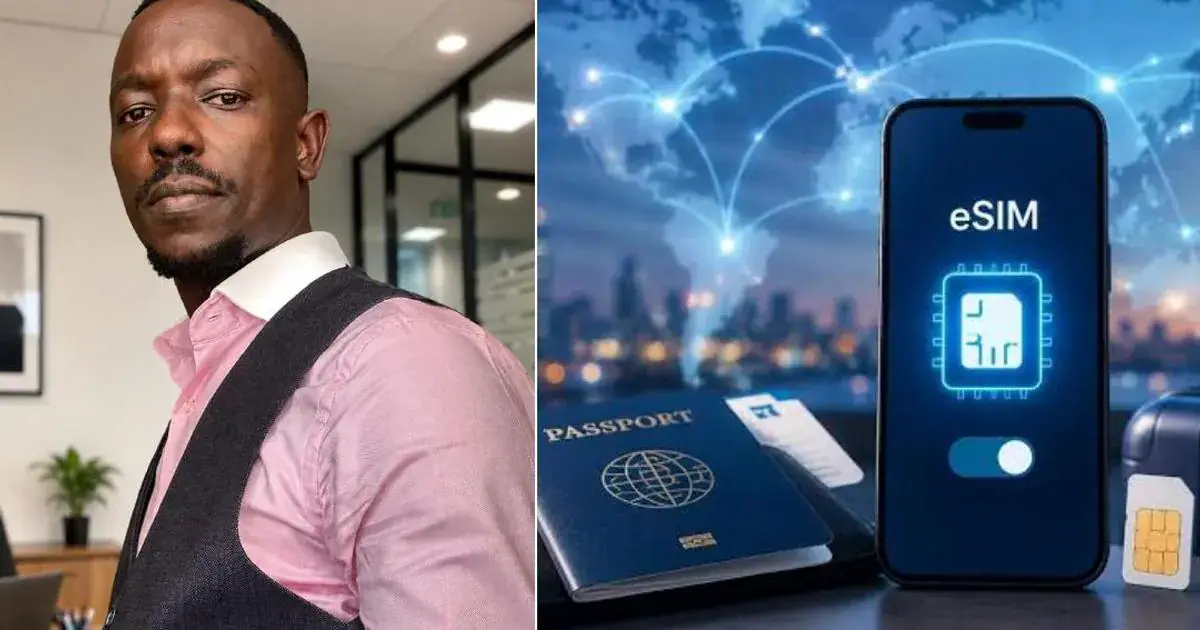
A delayed WhatsApp message that caused confusion at an airport in 2024 has inspired Geoffrey Mbuthia, Chief Operations Officer at Esivo Limited, to develop SafSIM, a Kenyan startup that offers affordable cross-border mobile connectivity. Mbuthia's experience highlighted the challenges travellers face when moving between mobile networks and countries. He founded SafSIM to help international travellers avoid expensive roaming fees, unreliable airport Wi-Fi, and the inconvenience of purchasing and registering a new SIM card whenever they arrive in another country.
SafSIM uses electronic SIM (eSIM) technology, allowing users to connect to mobile networks abroad without physically removing or replacing their existing SIM cards. The company officially launched in April 2026 and has since connected more than 500 customers and established working relationships with 20 tour and travel companies in Kenya. SafSIM's target market includes tourists, students, business travellers, travel agencies, tour operators, and companies whose employees frequently travel abroad.
The idea behind SafSIM emerged after Mbuthia went to an airport in 2024 to pick up a friend whose flight was expected to land at 5.45pm. When she did not arrive as scheduled, he waited until about 8pm before contacting her family and the airline to establish what had happened. He was eventually informed that the flight had been rescheduled to land at 10.45pm. However, his friend had already sent him a WhatsApp message at around 3pm explaining the change, which failed to reach him due to lost connectivity.
SafSIM is designed to give travellers access to mobile connectivity without the need to purchase physical SIM cards at their destinations. The service targets people who often have to choose between paying high international roaming charges and searching for local network providers after arriving at an airport. Development of the platform began in 2025, followed by testing and pilot operations between January and March 2026.
Despite the potential of eSIM technology, SafSIM faces an obstacle that could limit its growth: not all smartphones support electronic SIM cards. A considerable number of Kenyans still use devices that are incompatible with eSIM technology, leaving them unable to access services such as SafSIM through their existing phones. To address the challenge, the company is working on an alternative that would allow people with incompatible devices to use its services.
SafSIM's position is that access to affordable international connectivity should not depend on whether a traveller owns the latest mobile device. The company is also working to overcome limited public awareness of eSIM technology, educating potential customers on the technology while competing with established international connectivity providers. Part of its marketing approach involves encouraging travellers to organise their internet access before departure instead of waiting until they arrive at their destinations.
SafSIM's early customer base includes tourists, students, and business travellers, including media personality Jeff Koinange and artist Wanja Asali. The company is positioning itself as a Kenyan-founded technology business with plans to serve travellers beyond the country's borders. Its long-term ambition is to become a global connectivity partner for people travelling internationally, reducing the difficulties associated with accessing mobile services in unfamiliar destinations.
Key points
- SafSIM uses eSIM technology to provide affordable international mobile connectivity to travellers.
- The company has connected over 500 customers and established relationships with 20 tour and travel companies in Kenya.
- SafSIM is working to address smartphone compatibility and expand its relationships with travel agencies, tour operators, and businesses.