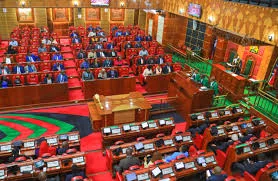
The Kenyan Parliament's Petitions Committee has tabled a report calling for urgent action to address the thriving illicit alcohol trade in the country. The committee, led by Runyenjes MP Muchangi Karemba, has proposed a series of measures to combat the trade, including tougher penalties for offenders and tax relief for legitimate manufacturers. The report was submitted following a petition by Uasin Gishu Woman Representative Gladys Boss on behalf of her constituents.
According to the committee's report, illicit alcohol accounts for 59 per cent of the market by volume and 21 per cent by value, estimated at Sh67 billion in 2022. This has resulted in an estimated Sh71 billion in lost revenue for the government, with distilled spirits accounting for the largest share of the tax leakage. The report also notes that the illicit trade across all sectors has risen from Sh726 billion in 2017 to Sh826 billion in 2025.
The committee has identified high taxes on legal alcohol, corruption, porous borders, and weak enforcement as key factors sustaining the illicit trade. It found that illicit products can be 38 to 80 per cent cheaper than legal alcohol, giving consumers and traders a strong financial incentive to operate outside the law. The committee also cited uneven licensing across the 47 counties as creating loopholes that traders exploit to evade regulation.
To make legal alcohol more competitive, the committee wants the National Treasury Cabinet Secretary to fully operationalise the Excise Duty (Remission of Excise Duty) Regulations, 2026. This measure has been described as critical by the Alcoholic Beverages Association of Kenya, as it will help reduce the price gap between legal and illicit products. The committee also wants the Interior Cabinet Secretary and the Council of Governors to develop proposals harmonising national and county alcohol control laws.
The committee is also calling for amendments to several laws, including the Alcoholic Drinks Control Act and the Anti-Counterfeit Act, to introduce tougher sanctions commensurate with economic crimes. MPs want to increase fines and introduce criminal liability for beneficial owners of companies involved in offences. Additionally, the committee wants the Agriculture Cabinet Secretary and Kenya Sugar Board to tighten controls over molasses-based ethanol production.
The National Police Service reported 35,700 arrests and the seizure of 1.56 million litres of illicit brew between January 2024 and May 2026. Of the seized volume, 949,800 litres were destroyed. In Uasin Gishu, police arrested 672 suspects and seized 46,383 litres during the same period. The Anti-Counterfeit Authority reported seizing 14,930 pieces of counterfeit alcohol worth Sh4 million between January and April 2026.
The committee has given the government 90 days to report on its progress in implementing the proposed measures. The recommendations followed submissions from 11 stakeholders who appeared before the committee. Key stakeholders, including the Council of Governors and the Alcoholic Beverages Association of Kenya, have welcomed the report, calling for a national-county alcohol control framework and a traceability system to track products through the supply chain.
Key points
- The Kenyan government has been given 90 days to implement measures to curb the illicit alcohol trade.
- Illicit alcohol accounts for 59 per cent of the market by volume and 21 per cent by value, estimated at Sh67 billion in 2022.
- The committee's report proposes tougher penalties for offenders and tax relief for legitimate manufacturers to combat the illicit trade.