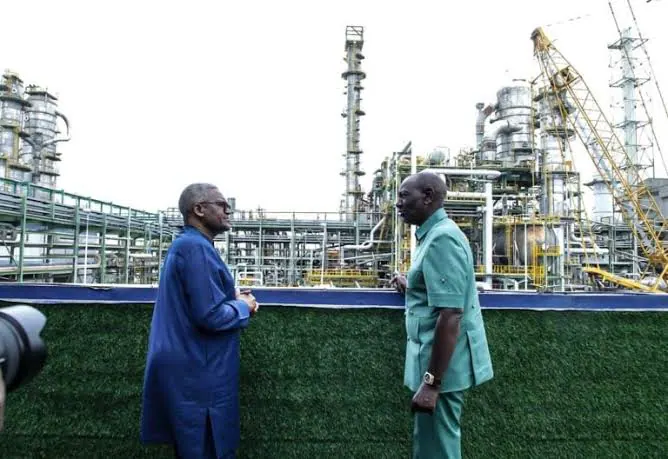
Kenyan Member of Parliament Antony Kibagendi has raised concerns over President William Ruto's decision to invest in the proposed Ksh2.23 trillion Dangote East Africa Petroleum Refinery in Lamu without parliamentary approval. Kibagendi, who represents Kitutu Chache South, argued that the Constitution grants Parliament the power of the purse and that any commitment of public assets on such a massive scale must be scrutinized and approved by lawmakers. He expressed alarm over the growing pattern of opacity surrounding major state-backed investments.
Kibagendi made these remarks during a televised interview on October 5, 2026, where he questioned the government's decision to bypass proper oversight mechanisms. He took particular issue with President Ruto's announcement at the groundbreaking ceremony in Mokowe, Lamu, where the President disclosed that Kenya would commit public assets, prime land, and National Infrastructure Fund capital to secure a state stake in the mega-refinery. Kibagendi emphasized that Parliament must okay any form of heavy investment involving public resources.
The MP also poured cold water on government projections regarding job creation and fuel price reductions. Comparing the venture to Dangote's existing plant in Nigeria, Kibagendi noted that the Nigerian facility employs roughly 3,000 to 4,000 workers and has done little to reduce local pump prices. He dismissed claims that the Lamu project would generate tens of thousands of local jobs, citing the Nigerian example as evidence that such projections may be exaggerated.
President Ruto has defended the financing strategy, asserting that 21st-century infrastructure demands innovative funding mechanisms that leverage public capital to attract private institutional investors. However, with opposition MPs raising critical questions over ownership terms, land allocation, and fiscal transparency, the multi-trillion-shilling refinery deal faces mounting Parliamentary resistance. Kibagendi's concerns reflect a growing debate over the government's approach to large-scale investments.
The Dangote East Africa Petroleum Refinery is a significant project that has garnered attention from various stakeholders. The project's proponents argue that it will help address Kenya's fuel needs and create jobs. However, critics like Kibagendi argue that the government's approach lacks transparency and that Parliament must be involved in the decision-making process. The project's impact on the local economy and environment remains a topic of discussion.
The Kenyan government has been keen to attract foreign investment to boost economic growth. The Dangote refinery deal is one of several large-scale projects aimed at driving economic development. However, the government's approach to such projects has raised concerns among lawmakers and civil society groups. The debate over the Dangote refinery deal highlights the need for greater transparency and accountability in large-scale investments.
The outcome of the debate over the Dangote refinery deal remains uncertain. While the government is keen to push ahead with the project, opposition from lawmakers like Kibagendi may force a re-evaluation of the investment strategy. Ultimately, the project's success will depend on the government's ability to balance economic growth with transparency and accountability.
Key points
- Kenyan MP Antony Kibagendi challenges President William Ruto's authority to invest in a Ksh2.23 trillion Dangote refinery without parliamentary approval.