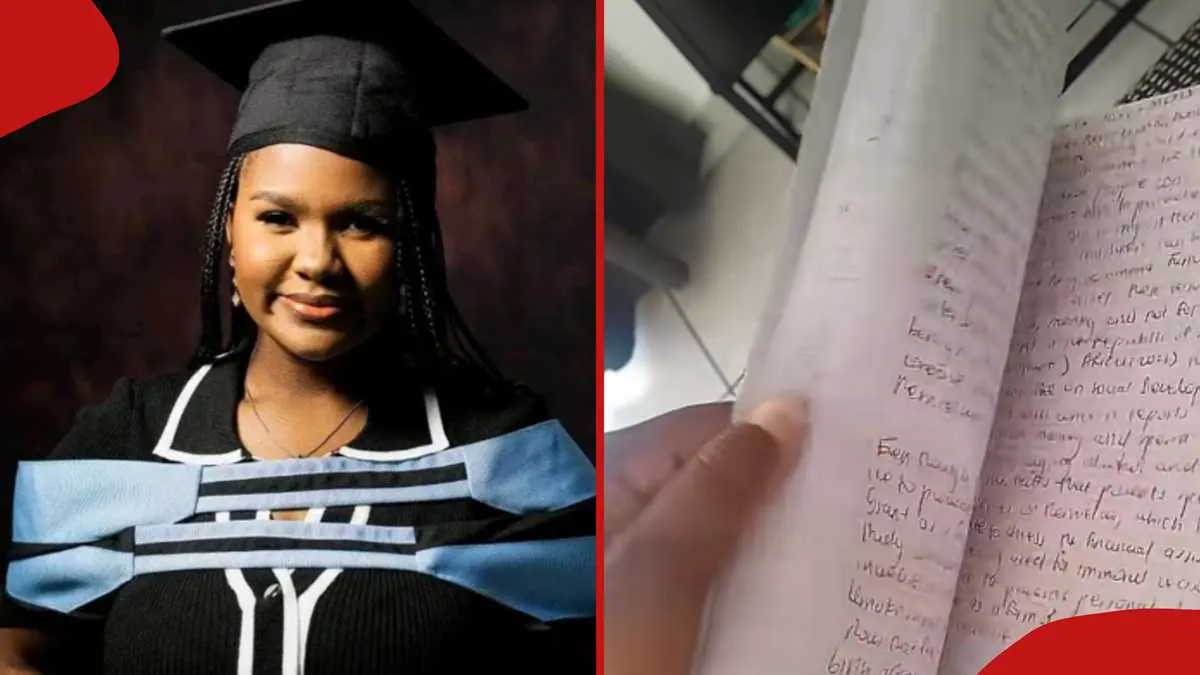
Dr. Moleki, a female academic, shared a TikTok video on September 26 flipping through the densely filled pages of her notebook, saying the method had served her since her undergraduate years. The video went viral, prompting strong opinions from students about writing by hand versus typing. Her approach involved handwriting as the first stage of her academic process to think through and draft her ideas before committing them to a screen.
Rather than typing directly into a document, Dr. Moleki treated handwriting as a crucial part of her writing process. She noted that this approach was not a one-off experiment but a habit she had relied upon throughout her academic career, going all the way back to her undergraduate studies. The sheer volume of work on display made it clear this was no casual note-taking exercise.
Completing a Master's dissertation at that word count is demanding enough when working directly on a laptop, but Dr. Moleki did it twice, first on paper and then on a keyboard. This speaks to an extraordinary level of commitment and discipline. Her method may not suit everyone, but the packed notebook she held up as proof left little room to argue with the results.
The video quickly gained traction online, drawing strong opinions from students who recognised the tension between old-school writing habits and the convenience of modern technology. Some viewers found the video inspiring, while others found it exhausting. Many could not imagine voluntarily doubling their workload, but others recognised something familiar in the idea that putting pen to paper first can produce clearer thinking.
Several students reacted to the video on social media, with some questioning the practicality of Dr. Moleki's approach. One viewer suggested taking pictures of the handwritten notes and sending them to a writing assistant, while another mentioned having to unlearn this habit in their first year of university. Others shared their own writing processes, including using voice records and transcription.
Dr. Moleki's method sparked a wider conversation about the role of handwriting in academic work. While some students prefer typing for its convenience and speed, others find that handwriting helps them think more clearly and retain information better. Dr. Moleki's experience shows that there is no one-size-fits-all approach to academic writing.
The story of Dr. Moleki's handwritten dissertation has resonated with many students, including those who have had to find creative ways to balance their academic and financial responsibilities. For example, a Kenyan university student, Esther Opia, sells bananas and snacks to pay her rent and school fees while pursuing her graduation dream, documenting her journey on social media to inspire young girls facing poverty and personal loss.
Key points
- Dr. Moleki handwrote her entire 40,000-word Master's dissertation in a notebook before typing it up.
- Her approach involved handwriting as the first stage of her academic process to think through and draft her ideas.
- The video sparked a wave of reactions online, with some students finding it inspiring and others exhausting.