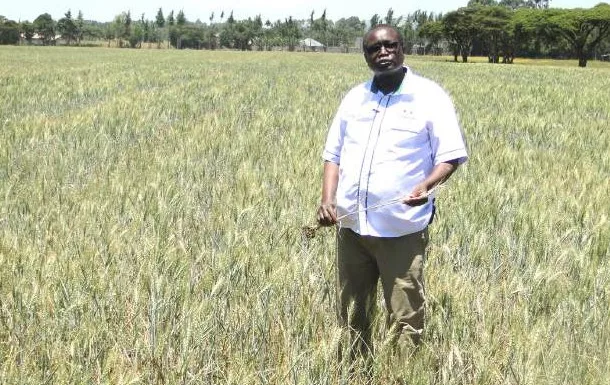
Vincent Chelule, a farmer from Chesoton, Njoro, has been growing wheat since 1994, inspired by his father's farming traditions. However, rising production costs and declining yields led him to abandon wheat farming for a period. He later returned to farming, working with the Kenya Agricultural and Livestock Research Organisation (KALRO) as a contracted seed producer. Chelule has about 20 acres of land, rotating crops and dedicating around 10 acres to wheat production.
Chelule's decision to remain in wheat farming comes amid significant challenges, including high production costs, unpredictable weather, and poor prices. Kenya produces only a fraction of the wheat it consumes, relying heavily on imports to meet demand. In 2024, the country produced approximately 350,000 tonnes of wheat, while annual consumption was estimated at between 2.2 million and 2.4 million tonnes. Despite the demand, farmers struggle with expensive inputs, including seed, fertiliser, chemicals, fuel, machinery, and labour.
The cost of producing wheat has risen significantly, with Chelule estimating that it costs over Sh50,000 to farm an acre. Dr Martin Lagat, a wheat breeder at KALRO's Njoro centre, attributes the decline in wheat production to high costs, expensive land, labour, and farm inputs, as well as land fragmentation. Farmers must weigh the returns from wheat against other crops they could grow on the same land. In some areas, agricultural land is being subdivided for other uses, reducing the acreage available for wheat and other food crops.
KALRO is responding to the challenges by developing new wheat varieties through breeding programs. Since the mid-1970s, the organisation has released almost 40 wheat varieties aimed at improving yields and disease resistance. Modern varieties have a potential yield of around eight tonnes per hectare, compared to 1.5 tonnes for varieties released in the 1970s. However, limited resources for promoting newer varieties and gaps in seed availability have slowed variety replacement.
Chelule's relationship with KALRO has made him interested in disease-resistant varieties, particularly those that can withstand wheat rust. He works with KALRO to grow varieties developed through research, including the Jacana variety, which performed well in his farm. Dr Zennah Kosgey, a plant pathologist at KALRO's Njoro research station, studies wheat diseases, including stem rust and yellow rust, and screens thousands of wheat lines for resistance.
The researchers at KALRO deliberately create conditions that allow diseases to develop to determine which wheat lines are resistant and which are susceptible. Breeders use this information to develop new varieties. However, resistance is not permanent, and pathogens can change, allowing diseases to overcome resistance. Kosgey advises farmers to combine resistant varieties with good crop management and approved fungicides, as well as early detection and scouting of fields.
For farmers like Chelule, early detection of diseases is crucial to preventing yield losses. Despite the challenges, Chelule remains committed to growing wheat, driven by his passion for farming and his desire to contribute to Kenya's food security. His story highlights the complexities of wheat farming in Kenya and the need for sustainable solutions to support farmers.
Key points
- Kenyan farmer Vincent Chelule continues to grow wheat despite high production costs and unpredictable weather.
- The country produces only a fraction of the wheat it consumes, relying heavily on imports to meet demand.
- KALRO is developing new wheat varieties through breeding programs to improve yields and disease resistance.