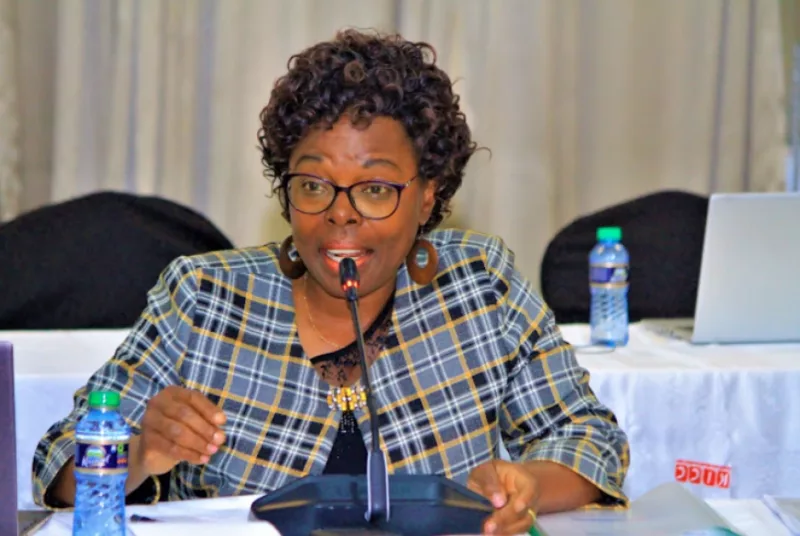
County governments in Kenya collected Sh97.55 billion in own-source revenue for the 2025-26 financial year, falling short of their combined target of Sh108.40 billion. This represents 89.99% of their target, according to a report by the Controller of Budget, Margaret Nyakang'o. Despite missing the target, the collections were 44.95% higher than the Sh67.30 billion raised in the 2024-25 financial year. The report highlights that 15 counties exceeded their individual revenue targets, while 12 recorded performance below 70%.
Mombasa County emerged as the top performer, achieving 251.8% of its annual target, albeit from arrears of previous years. The county collected Sh21 billion against a target of Sh8.39 billion. Garissa recorded the highest performance against its target at 165.51%, followed by Kirinyaga at 145.37%, Samburu at 132.73%, and Trans Nzoia at 116.62%. Other counties that exceeded their targets included Vihiga, Tharaka-Nithi, Laikipia, Lamu, Makueni, Kajiado, Nyeri, Narok, Wajir, and West Pokot.
The report attributed the overall increase in collections partly to stronger Facility Improvement Financing (FIF), including reimbursements under the Social Health Insurance Fund, revenue arrears, and tourism-related receipts. Ordinary own-source revenue accounted for Sh55.69 billion of the total collections, while FIF contributed Sh39.75 billion. Appropriations-in-Aid and other revenues contributed Sh649.27 million and Sh1.47 billion, respectively.
However, the Controller of Budget raised concerns over counties' growing reliance on FIF, which accounted for 40.75% of total own-source revenue. Garissa was the most dependent on FIF, with the stream accounting for 88.18% of its total own-source revenue. The CoB urged counties to diversify their revenue streams to reduce their dependence on FIF proceeds.
The report also revealed that counties had accumulated Sh113.29 billion in revenue arrears by June 30, 2026. Nairobi accounted for more than half of the outstanding revenue at Sh59.09 billion, equivalent to 52.15% of the total. The CoB attributed the underperformance of some counties to weak collections from ordinary revenue streams, failure to use revenue forecasting tools, and poor performance in FIF streams.
Twelve counties recorded OSR performance below 70%, with three counties reporting OSR performances of less than 50%. These counties are Kisumu at 49.77%, Kajiado at 49.04%, and Siaya at 26.94%. The CoB has called for stronger revenue collection measures in the current financial year, directing counties to set realistic revenue targets and develop plans to recover outstanding arrears.
The CoB further urged counties to prioritize development projects, finalize procurement and cash flow plans early, and submit exchequer requisitions promptly. Counties have also been advised to contain payroll costs through staff rationalization as they seek to improve their financial position. The Sh113.29 billion in outstanding revenue presents a major collection opportunity for counties as they seek to bridge the gap without placing additional pressure on residents and businesses.
Key points
- Kenyan counties collected Sh97.55 billion in own-source revenue, missing their target by Sh10.85 billion.
- FIF accounted for 40.75% of total own-source revenue, raising concerns over counties' reliance on this stream.
- Counties accumulated Sh113.29 billion in revenue arrears by June 30, 2026, with Nairobi accounting for over half of the outstanding revenue.