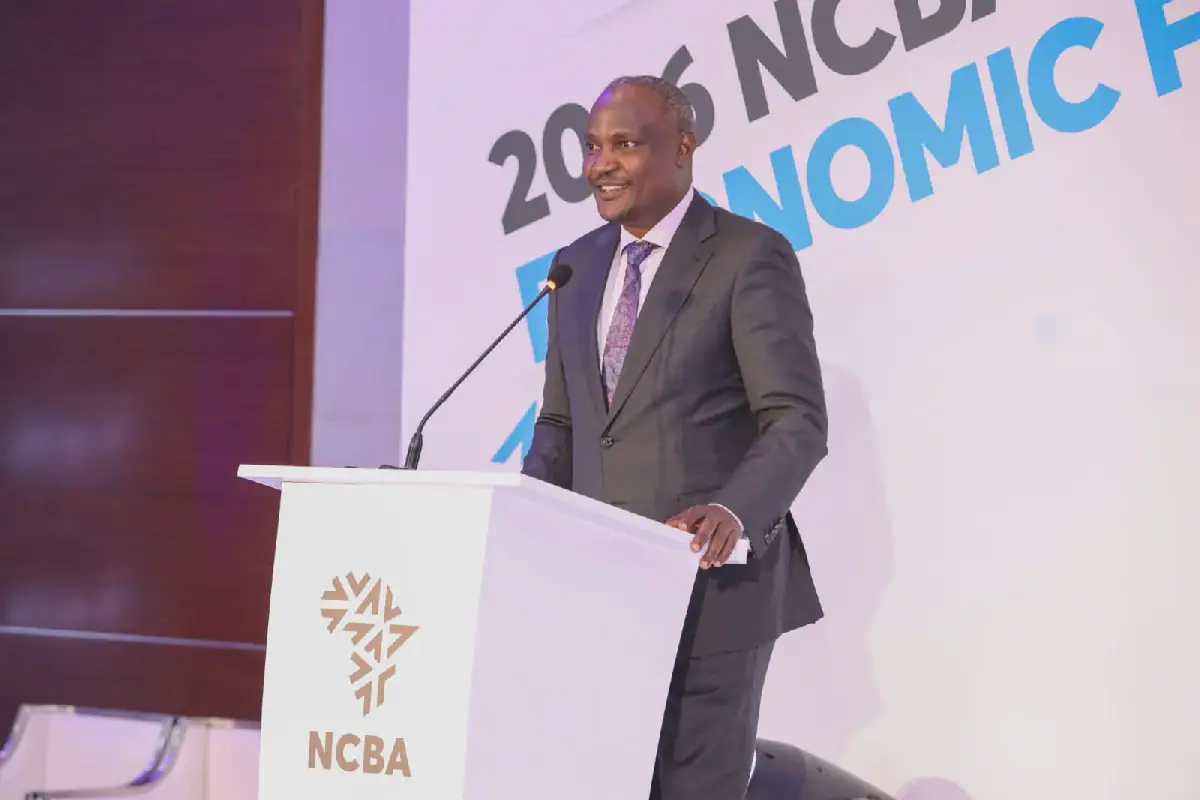
Kenyan banks have been urged to pass on the recent rate cuts to productive sectors to boost economic growth. National Treasury Cabinet Secretary John Mbadi stated that despite the Central Bank of Kenya lowering the Central Bank Rate by 4 percentage points since mid-2024, the average lending rate remains high at 14.4%. Mbadi emphasized that borrowers should feel the impact of the rate cut and that banks should lend more to the real economy.
Mbadi made these remarks during the 2026 NCBA Economic Forum, where he highlighted that the government is now borrowing less from banks, creating room for them to lend to businesses, farmers, manufacturers, and Micro, Small, and Medium Enterprises (MSMEs). The Treasury CS encouraged banks to utilize this room to support economic growth. This call comes as inflation in Kenya has risen to 7.3% in October, largely due to the increased cost of fuel.
The National Treasury Cabinet Secretary's comments are supported by projections from the NCBA Group, which forecasts that Kenya's GDP growth will be 4.8% this year and 4.5% next year. The growth is expected to be driven by steady performance in various sectors, although services and industry are projected to grow at a slower pace. According to Raphael Agung', NCBA Group Director for Global Markets, Kenya has remained resilient despite global economic shocks.
Policymakers believe that to overcome global shocks and achieve robust economic growth, Kenya needs to target an annual growth rate of at least 6%. However, World Bank Division Director Dr. Qimiao Fan noted that growth vulnerabilities still exist due to pressures on public finance and fiscal deficit stemming from high public debt. Dr. Fan emphasized that consistent fiscal deficits and high debt service costs constrain fiscal space.
Kenya's public debt has grown to Ksh 13.5 trillion, making up more than 70% of the country's GDP, with interest payments absorbing an estimated one-third of government revenue. The NCBA Group projects that Uganda, Rwanda, and Tanzania will outperform Kenya next year, with growth rates of 7%, 7%, and 6%, respectively. This has raised concerns about Kenya's economic performance.
The economic challenges facing Kenya are further complicated by the ongoing global economic shocks, including the war in the Middle East, which has disrupted energy supply routes. The NCBA Group's projections suggest that Kenya's economic growth will be impacted by weak growth in services and industry.
To address these challenges, the Kenyan government and policymakers are working to implement strategies that will support economic growth and stability.
Key points
- Kenyan banks are urged to pass on rate cuts to productive sectors to boost economic growth.
- Kenya's public debt has grown to Ksh 13.5 trillion, making up more than 70% of the country's GDP.
- Policymakers believe Kenya needs to target an annual growth rate of at least 6% to achieve robust economic growth.