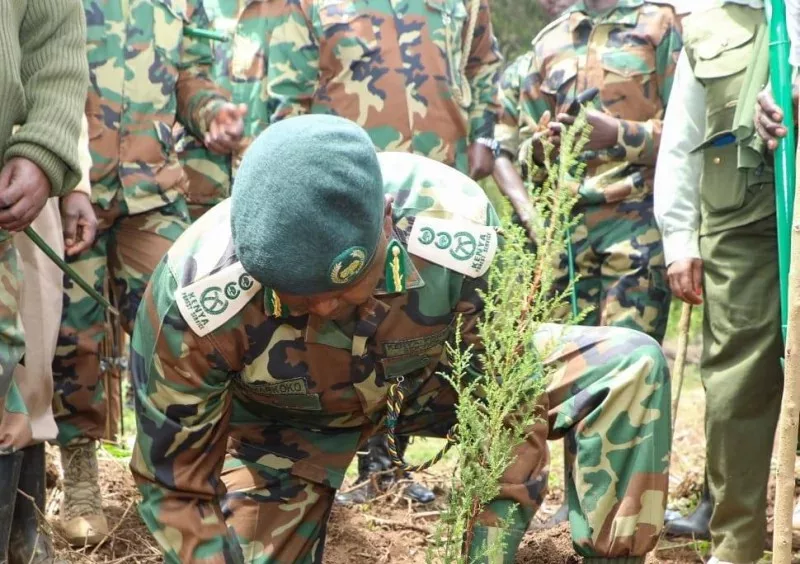
Kenya is seeking to transform its forestry sector from a mainly conservation activity to a source of investment, jobs, and economic growth. The country has approved $229 million in new external finance for forest- and landscape-based economic development. This funding includes $200 million from the World Bank and $29.2 million from the Green Climate Fund for Kenya's Lake Region. The goal is to turn the country's 15 billion tree-growing plan into measurable gains.
Despite the country's efforts to increase forest cover, the Kenya National Bureau of Statistics' Economic Survey 2026 shows that the area of newly established forest plantations fell to 4,400 hectares in 2025 from 4,900 hectares a year earlier. National forest cover remained at 8.8 percent. Experts argue that the bigger economic question is whether Kenya can turn restoration, commercial tree growing, and sustainable forestry into a bankable industry capable of generating jobs and supporting farmers.
The Forest & Climate Leaders' Partnership 2026 Forest Finance Roadmap points to treating forests as part of the wider economic system rather than as an environmental expenditure. The report highlights that Kenya increased its 2025-26 fiscal year forestry budget by approximately $38.7 million and maintained a higher allocation of about $143.8 million for the 2026-27 financial year. The Industrial Wood Sector Vision 2050 estimates that the country will ultimately require about Sh176 billion to develop commercial tree growing and wood processing.
The Industrial Wood Sector Vision 2050 projects a much larger forestry industry, with GDP contribution potentially rising from about Sh5 billion today to Sh137 billion by 2050. The vision also envisages full-time jobs increasing from 15,000 to 85,000 annually and household participation rising from 2.7 million to 7.5 million growers. The Ministry of Environment, Climate Change and Forestry has framed this shift as green industrialisation, with private-sector investment in more productive plantations and efficient processing central to achieving the projected growth.
Principal Secretary in the State Department for Forestry Gitonga Mugambi is calling for stronger collaboration between government, private investors, researchers, and communities to develop Kenya's forestry value chain. He argues that investment, research, supportive policies, and market development would be necessary to turn forests and bamboo into a competitive source of jobs and green growth. Kenya had launched the National Commercial Forestry Strategy 2025-2035, which seeks to expand climate-smart plantations and attract investment into the sector.
President William Ruto has linked environmental restoration to employment and economic development, saying expanded carbon markets could generate hundreds of millions of dollars in income and create hundreds of thousands of green jobs. The FCLP report says the global forest-finance system remains heavily dependent on public and development finance, with private capital still needing to be unlocked at a much larger scale. For sustainable forest bio-economies, at least $1.73 billion was mobilised globally by multilateral development banks and climate funds in 2025/26.
The FCLP recommends concessional, catalytic, and patient capital, including guarantees and blended finance, to reduce investment risks in restoration. With the right investment and policies, Kenya's forestry sector could become a significant contributor to the country's economy and provide new opportunities for jobs and growth. The country's progress towards its 15 billion trees target and the development of its forestry sector will be closely watched in the coming years.
Key points
- Kenya has approved $229 million in new external finance for forest- and landscape-based economic development.
- The country's 15 billion tree-growing plan aims to increase forest cover and create new economic opportunities.
- The forestry sector could contribute Sh137 billion to Kenya's GDP by 2050 and create 85,000 full-time jobs.