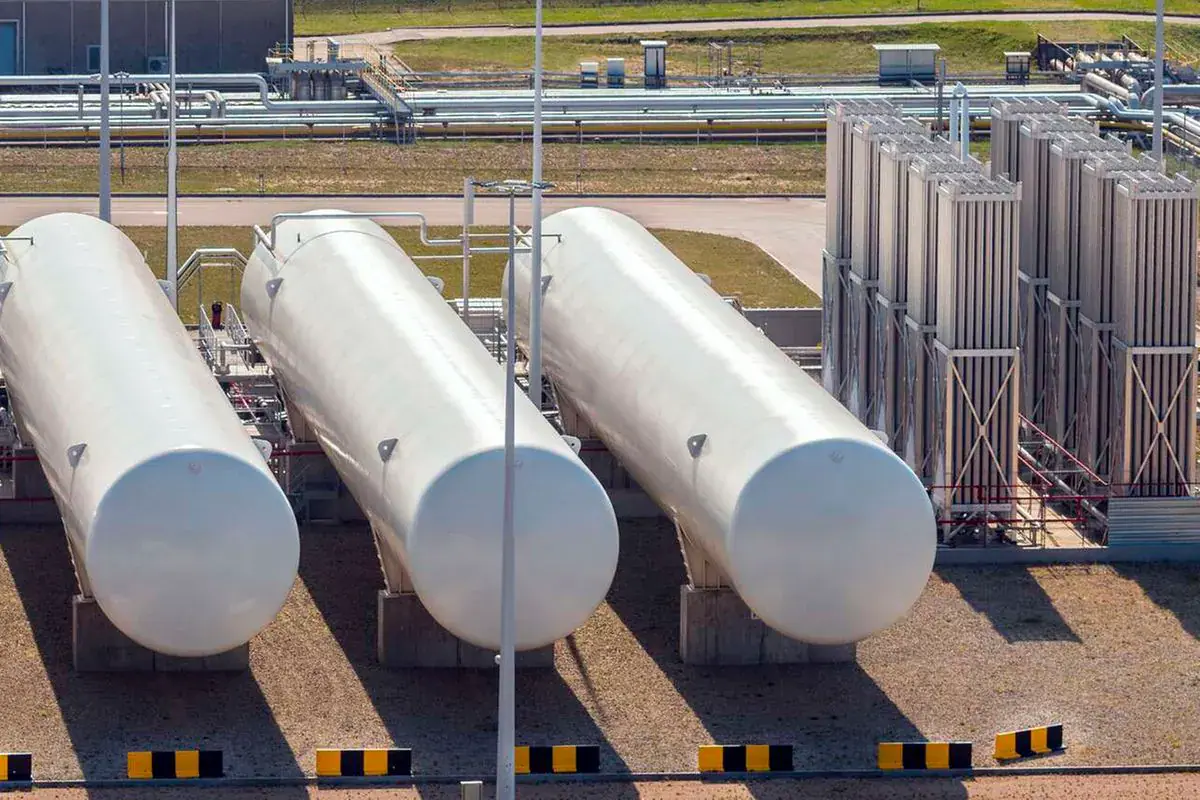
Kenya is set to invest in its first natural-gas powered electricity generation plant, estimated to cost Sh39 billion. The plant, located at Dongo Kundu in Mombasa, will be on a floating barge and use Liquefied Natural Gas (LNG) to produce up to 1,200 Megawatts (MW) of electricity. The project is expected to help alleviate the country's power generation struggles. Investors will own and operate the plant for 30 years to recoup their money via the Build-Own-Operate or Build-Own-Operate-Transfer model.
The National Treasury estimates that the LNG plant will be critical in reducing Kenya's reliance on costly thermal power, particularly during peak demand in the evenings and during drought seasons when hydropower generation is low. Thermal power is the most expensive in the national grid, with a unit costing $0.269 (Sh34.95), which is 10 times the $0.025 (Sh3.26) for the same unit of locally-produced hydropower. The Ministry of Energy and Petroleum notes that LNG-to-power projects are increasingly adopted as part of national energy transition strategies.
A floating barge power plant is a special ship that supplies electricity independently of local resources or infrastructure, using natural gas or diesel to generate electricity. Kenya does not have confirmed reserves of LNG and plans to import the commodity from Tanzania or other countries. In 2021, Kenya signed an agreement with Tanzania to build a pipeline to evacuate LNG from Mtwara in Tanzania to the port of Mombasa.
Currently, Kenya Power relies on seven thermal plants for electricity, mostly during peak evening demand and to stabilize supply in the Coast region. Two of the biggest thermal power plants are located at the Coast and accounted for a combined 77 percent of the 1.04 billion kilowatt-hours (kWh) of thermal power that Kenya Power bought in the year ended June 2025.
The high usage of thermal power results in steep bills for consumers, mainly in the form of the fuel surcharge, which compensates thermal power plants for their fuel costs. The fuel surcharge, or Fuel Cost Charge (FCC), increases with costly fuel and usage of thermal power. Disclosures show that the LNG plant will be set up in stages, with 300,000 kilowatts (kW) this year, a similar amount by 2028, and 600,000 kW in 2032.
Kenya Power has increased its reliance on imported electricity from Ethiopia and Uganda to meet demand and avert widespread rationing. A successful deployment of the LNG plant will enable Kenya to join other African economies, such as Mozambique, Algeria, Egypt, and Tunisia, that heavily rely on natural gas for power generation.
The LNG-to-power project offers a flexible, relatively fast-to-deploy, and lower-carbon transitional solution that enhances energy security while supporting industrial growth. The Ministry of Energy and Petroleum notes that such projects are increasingly adopted in emerging markets seeking reliable, scalable, and cleaner power generation.
Key points
- The project is expected to cost Sh39 billion and produce up to 1,200 MW of electricity.
- The plant will help reduce Kenya's reliance on costly thermal power.
- The LNG plant will be set up in stages, with initial capacity of 300,000 kW this year.