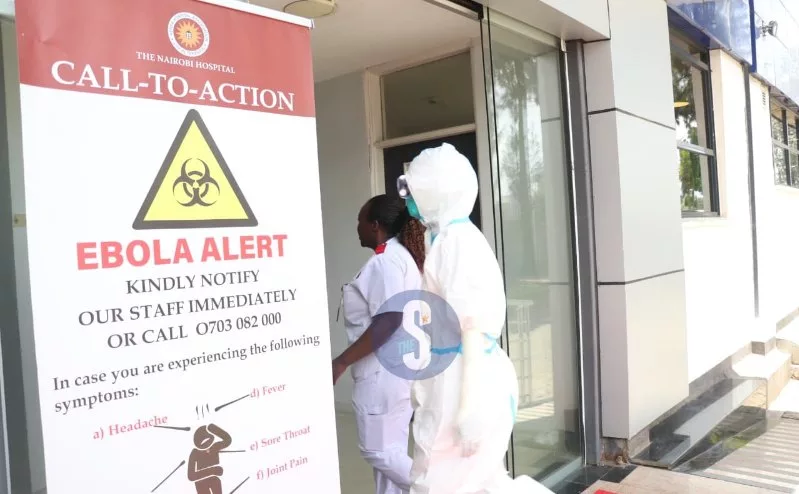
Kenya has introduced stricter Ebola screening measures for travellers arriving from 10 countries, following its first confirmed imported Ebola case and subsequent death. The enhanced surveillance applies to passengers from the Democratic Republic of Congo, Uganda, Tanzania, Rwanda, Burundi, Angola, Zambia, Ethiopia, South Sudan, and the Central African Republic. These travellers will undergo additional health screening at the Jomo Kenyatta International Airport.
The new measures were announced by Health Cabinet Secretary Aden Duale, who stated that aircraft arriving from the 10 countries will be directed to Gate 16 at JKIA for enhanced health screening. Passengers will be screened for signs of illness and required to provide information through health declaration forms before proceeding into the country. This move aims to mitigate the spread of the disease and protect the public against public health threats.
The first Ebola case in Kenya was confirmed in a traveller who entered the country from the Democratic Republic of Congo on October 3. The patient was admitted to Nairobi Hospital on Saturday but sadly died on Monday night. Following the patient's death, the Ministry of Health, in collaboration with the Kenya Red Cross Society, conducted a safe and dignified burial in line with public health measures on Tuesday.
To prepare for potential additional cases, the government has identified five hospitals to treat confirmed Ebola patients. These hospitals are Kenyatta National Hospital, Moi Teaching and Referral Hospital, National Police Hospital, Portreitz Hospital, and Nairobi Hospital, with a combined capacity of 241 beds. The capacity can be expanded depending on the situation's development. Furthermore, five facilities have been designated as temporary isolation centres for suspected cases.
In addition to the hospital preparedness, the government has intensified measures at the country's borders, particularly at entry points for travellers from neighbouring countries. Health officials are urging the public to remain alert but calm as the government continues contact tracing and surveillance. The public is advised to maintain good hand hygiene, avoid contact with people showing symptoms of illness, and report suspected cases to health authorities.
The Ministry of Health is working with county governments and other health facilities to strengthen surveillance and prepare for a possible increase in suspected cases. The National Treasury has set aside an initial Sh2.6 billion for Ebola preparedness and containment. The ministry is also working to mobilize additional resources for the response and has urged Kenyans to rely on official Ministry of Health communication channels for accurate information.
Health officials are continuing efforts to locate and monitor the contacts of the confirmed Ebola patient, with those already quarantined being observed for symptoms. The current case is considered an imported infection, and the ministry is managing it through contact tracing, quarantine, enhanced surveillance, and treatment preparedness. The public is encouraged to seek care at recognized health facilities if unwell and report any known unwell individuals to the nearest facility.
Key points
- Kenya introduces enhanced surveillance for travellers from 10 countries amid its first confirmed Ebola case and death.
- The government has identified five hospitals to treat confirmed Ebola patients, with a combined capacity of 241 beds.
- The National Treasury has set aside an initial Sh2.6 billion for Ebola preparedness and containment.