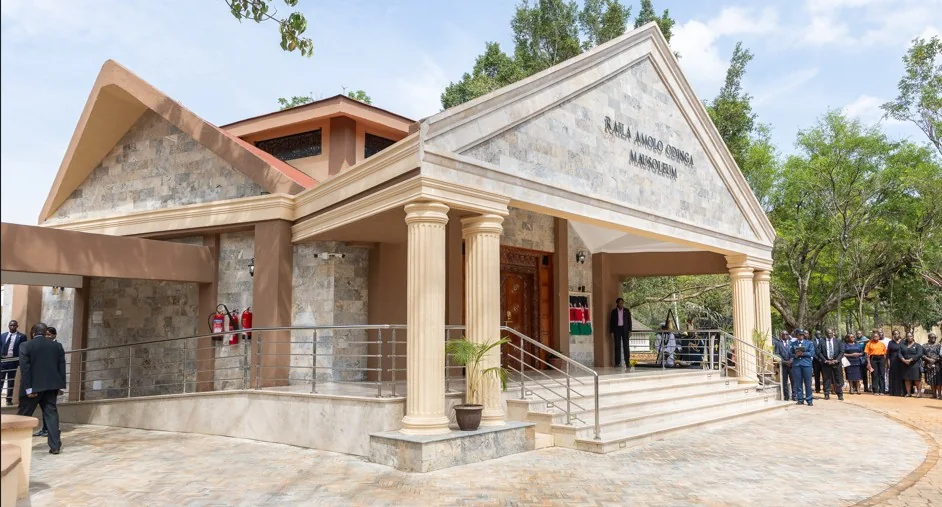
Kenya's political leaders' mausoleums serve as more than final resting places, offering insight into the lives, struggles, and legacies of figures who shaped the nation's history. These structures have become symbols of the leaders' contributions and ideologies. The designs of the mausoleums are a reflection of the leaders' personalities and accomplishments.
The Raila Odinga Mausoleum at Kang'O Ka Jaramogi in Bondo, Siaya County, features a pentagonal design inspired by Odinga's raised fist, a symbol of authority, power, and unity. The pentagon also echoes the "Pentagon" term used for the top five ODM leaders during the 2007 presidential race. This design element links the geometry to Odinga's political history.
The Raila Odinga Mausoleum site includes a paved walkway, landscaped buffers, wildlife sculptures at the entrance, a black marble platform, and walls lined with backlit photographs, artwork, and a bronze portrait. These elements create a modern gallery of Odinga's democratic contributions. The mausoleum is situated near his father Jaramogi Oginga Odinga's hexagonal tomb.
Tom Mboya's mausoleum on Rusinga Island, built in 1971, adopts a bullet-shaped silhouette to reflect the manner of his 1969 assassination. The structure also features a coffin-shaped entrance and a cross denoting his Catholic faith. The design elements of the mausoleum are a reflection of Mboya's life and legacy.
Inside Tom Mboya's silver-coloured structure, his family preserves artefacts such as his briefcase, a black fly-whisk, the flag that draped his coffin, and a certificate of honorary citizenship from Kansas City. These items are displayed in lockable glass cabinets. The mausoleum, gazetted as a national monument in 2001, remains maintained by Mboya's family.
Jomo Kenyatta's final resting place near Parliament in Nairobi is tightly guarded, with photography prohibited and public access limited to the annual commemoration on August 22. The compound features paved walkways, evenly spaced flags, a black metal gate, and a bougainvillaea hedge. These elements are maintained by Parliament and Kenya Defence Forces soldiers.
The Kenya Defence Forces and Parliament are responsible for the maintenance of some of these mausoleums, ensuring their preservation for future generations. These structures serve as a reminder of the country's history and the leaders who shaped it. The mausoleums have become important historical sites, attracting both local and international visitors.
Key points
- The designs of Kenya's political mausoleums reflect the leaders' histories and ideals.
- The mausoleums serve as more than final resting places, offering insight into the lives and legacies of Kenya's leaders.
- The maintenance of the mausoleums is a shared responsibility between the families of the leaders and government institutions.