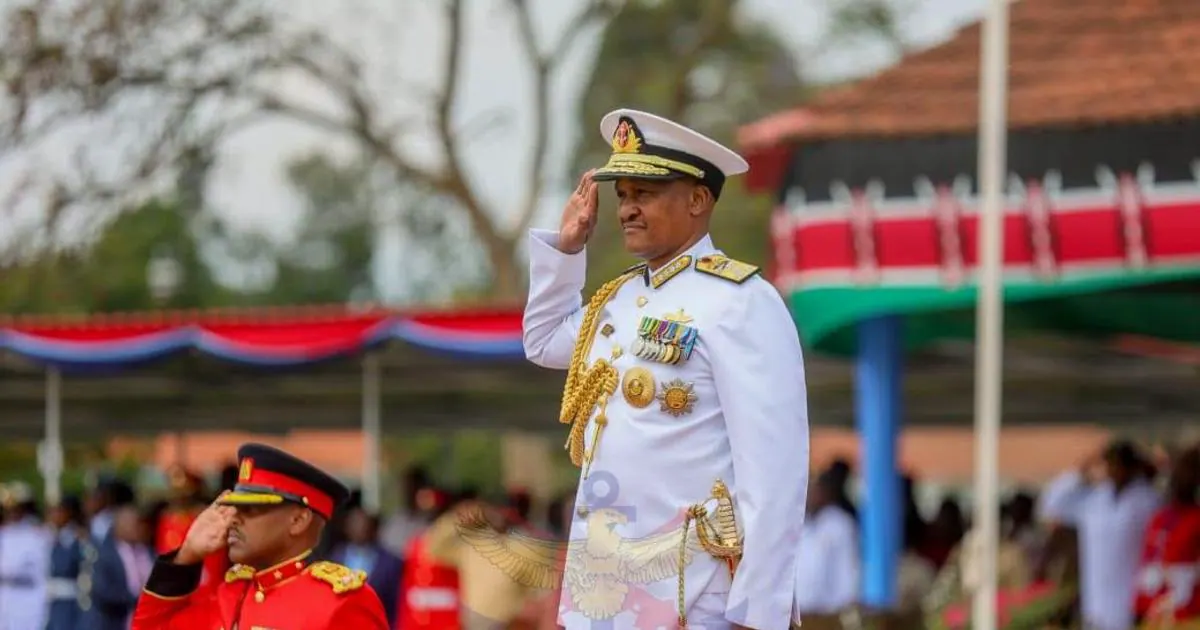
In Kenya, the President serves as Commander-in-Chief of the Kenya Defence Forces (KDF), but this does not necessarily mean they must personally preside over every military parade, graduation, or commissioning ceremony. The Constitution and the Kenya Defence Forces Act outline the President's role and responsibilities, but do not require a physical presence at all events. On September 17, 2026, Chief of Defence Forces General Charles Kahariri presided over a commissioning parade at the Kenya Military Academy on behalf of President William Ruto.
The ceremony at the Kenya Military Academy involved the commissioning of 129 Specialist and Special Duty Officer cadets. General Kahariri inspected the guard of honour and read the President's signed commissioning letter to the new officers. This demonstrates that the President's constitutional role in the appointment can be preserved even if they are not physically present at the ceremony. The distinction between presidential authority and ceremonial presence is an important one, as it highlights the different aspects of the President's role as Commander-in-Chief.
Article 131 of the Constitution establishes the President as Commander-in-Chief of the KDF, giving them constitutional authority over the Defence Forces. The Kenya Defence Forces Act also outlines the President's responsibilities, including the appointment of the Chief of Defence Forces, Vice Chief of Defence Forces, and Service Commanders. However, these responsibilities do not require a physical presence at all military ceremonies. The President's role is one of command responsibility, which is different from a ceremonial function.
The practice of representation at military ceremonies is not unique to Kenya. In the UK, for example, the monarch is not required to attend every ceremony personally. In 2026, Britain's Chief of the General Staff, General Sir Roly Walker, represented King Charles III at a parade. Similarly, in Kenya, there have been instances where the President has not presided over ceremonies. In April 2016, then Chief of Defence Forces General Samson Mwathethe presided over a commissioning parade on behalf of President Uhuru Kenyatta.
In contrast, President Ruto has personally presided over KDF officer commissioning ceremonies in March 2023, May 2024, and April 2025. This suggests that while representation is possible, presidential attendance is also a common practice. The record shows that presidential attendance is customary at major ceremonies, but representation has also occurred. This highlights the flexibility in the President's role and the ability to delegate representation.
The police system in Kenya is different from the KDF, with the Inspector-General exercising independent command over the National Police Service. Police pass-out ceremonies can involve different senior officials, and the President may not always be present. For example, on August 28, 2026, the President personally presided over a recruits' parade at Kiganjo. However, this does not set a precedent for military ceremonies.
In conclusion, the President of Kenya can delegate representation at military ceremonies without transferring constitutional authority as Commander-in-Chief. The person taking the salute is not necessarily the person who holds the authority behind the commission. This is an important distinction, as it highlights the different aspects of the President's role and the flexibility in their authority.
Key points
- The President of Kenya can delegate representation at military ceremonies without transferring constitutional authority as Commander-in-Chief.