Lake Ol Bolossat, Kenya's only natural high-altitude lake, has been a lifeline for the local community, providing water, farming, livestock, fishing, tourism, and other livelihoods for decades. However, the lake dried up in 2023 due to prolonged drought, human encroachment, and catchment degradation, causing panic among the community and leading to attacks by hippos that had sought refuge in a nearby public dam.
The Kenya Wildlife Service successfully translocated the hippos using technology, including 360-degree night vision monitoring equipment. The incident jolted the government, community, and NGOs into action, yielding positive results. Today, the lake's water is calm, with regular interruptions by hippos, indicating a functioning wetland ecosystem. Experts and community members emphasize that the lake's health is crucial to the community's future.
A study, "Unlocking Biodiversity Data to Facilitate Designation of Lake Ol Bolossat as the 7th Ramsar Site in Kenya," has mapped out the lake's biodiversity, recording 518 plant species, 162 bird species, and 278 fungi species. The report provides fresh evidence for stronger protection of the threatened wetland. Two plant species, Calceolaria tripartita and Lactuca serriola, were recorded for the first time in Kenya.
The assessment also found remarkable fungal diversity, with 278 fungal species documented, including 141 macrofungi and 25 arbuscular mycorrhizal fungi recorded for the first time. Bird surveys recorded 162 species, including 24 species of conservation concern, such as three endangered species and two vulnerable species. The survey also recorded migratory birds, including 20 Palearctic and two intra-African migrants.
The report emphasizes that Lake Ol Bolossat is not only an important biodiversity site but also an ecosystem with a much wider human significance, supporting the livelihoods of more than two million people and serving as an important water source for landscapes extending into Laikipia and Isiolo counties. However, the assessment also presents a warning about the pressures facing the ecosystem, including land conversion and illegal harvesting.
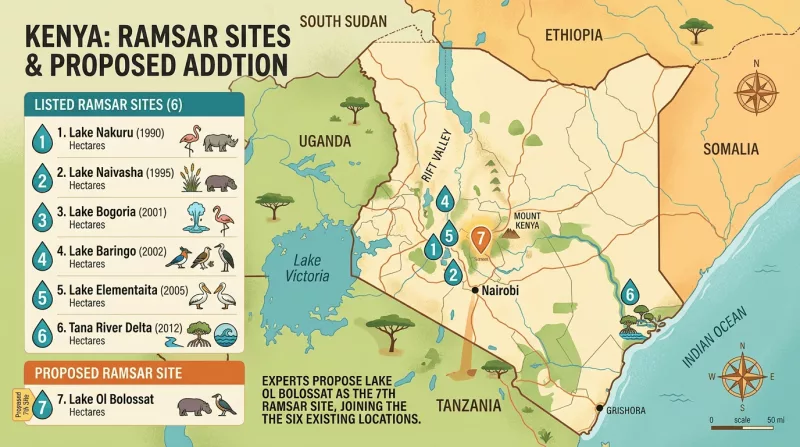
Plans are underway to declare Lake Ol Bolossat a Ramsar site, which would provide enhanced conservation and sustainable use. A Ramsar site designation signifies a commitment to the conservation and sustainable use of the wetland's resources, promoting international cooperation and effective monitoring and reporting. Kenya currently has six Ramsar sites, including Lake Nakuru, Lake Naivasha, and Lake Baringo.
The proposed designation of Lake Ol Bolossat as a Ramsar site would foster international cooperation, education, and public awareness. The site's identification and nomination are primarily the responsibility of the Kenyan government. If approved, the site would join six other Ramsar sites in Kenya, including Lake Nakuru, Lake Naivasha, Lake Bogoria, Lake Baringo, Lake Elementaita, and Tana River Delta.
Key points
- Lake Ol Bolossat is a vital ecosystem supporting the livelihoods of over two million people.
- The lake's biodiversity includes 518 plant species, 162 bird species, and 278 fungi species.
- Designating Lake Ol Bolossat as a Ramsar site would enhance conservation and sustainable use of its resources.