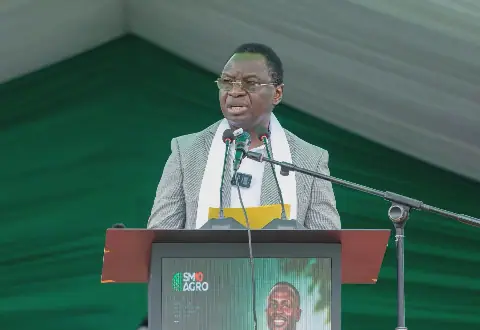
The Kenyan Ministry of Energy and Petroleum has defended the country's Government-to-Government fuel import arrangement, amid renewed scrutiny and claims of foul play. Energy Cabinet Secretary Opiyo Wandayi stated that the programme was introduced in 2023 to address an acute shortage of US dollars, which was threatening the supply of essential imports and putting pressure on the economy. The arrangement allowed for the importation of refined petroleum products on credit terms of up to 180 days, easing the immediate pressure on Kenya's dollar reserves.
Wandayi explained that prior to the arrangement, petroleum imports demanded a significant portion of the country's foreign exchange reserves, with payments required within five days of cargo arrival. The total import bill for refined petroleum products amounted to $500 million, accounting for about 35% of the total import bill. The government partnered with international oil companies, including Aramco Trading Fujairah FZE, Abu Dhabi National Oil Company Global Trading Ltd, and Emirates National Oil Company (Singapore) Private Limited.
Under the arrangement, the international oil companies appointed licensed Kenyan companies to handle local supply and logistics. The government provided a list of oil marketing companies for vetting, with Gulf Energy Limited, Galana Energies Limited, and Oryx Energies Kenya Limited among the first companies selected. Additional oil marketers were later brought into the arrangement, including One Petroleum Limited, Asharami Synergy Limited, and BE Energy Limited.
Wandayi also outlined changes in freight charges under the arrangement. Initially, freight costs stood at $97.50 per metric tonne for Super Petrol, $118 for diesel, and $114.25 for Jet A1. The rates were later reduced in September 2023, with Super Petrol freight falling to $90 per metric tonne, diesel to $88, and Jet A1 to $111.75. A further review in March 2025 reduced the agreed rates to $84 per metric tonne for Super Petrol, $78 for diesel, and $97 for Jet A1.
The ministry's defence comes amid renewed scrutiny of the fuel supply arrangement, following remarks by Uganda President Yoweri Museveni. Museveni stated that Uganda had previously been buying petroleum products through intermediaries in Kenya at higher premiums. He cited a Kenyan senator as alerting him to the arrangement, which Museveni claimed was unfair to Uganda.
According to figures cited by Museveni and Uganda's Permanent Secretary for Energy Irene Batebe, Uganda previously paid a premium of $118 per metric tonne for diesel, compared with $83 under its current arrangement with Vitol and Uganda National Oil Company. The premium for Super Petrol was said to have fallen from $97.50 to $61.50 per metric tonne, while the premium for aviation fuel dropped from $114.25 to $79.25 per metric tonne.
Wandayi defended the arrangement, stating that it had helped preserve Kenya's foreign exchange reserves while contributing to stability in the dollar-shilling exchange rate. The ministry maintains that the Government-to-Government arrangement was designed to address the country's foreign exchange constraints and safeguard fuel supplies.
Key points
- The arrangement allowed for the importation of refined petroleum products on credit terms of up to 180 days, easing pressure on Kenya's dollar reserves.
- The government partnered with international oil companies to supply refined petroleum products.
- The arrangement helped preserve Kenya's foreign exchange reserves and contributed to stability in the dollar-shilling exchange rate.