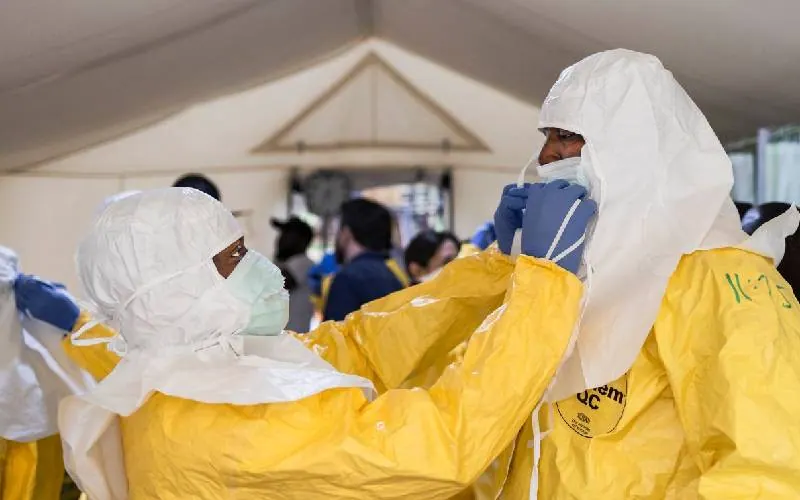
Kenya's confirmation of its first Ebola virus case has sent shockwaves throughout the region, with neighboring countries scrambling to strengthen their surveillance and emergency preparedness measures. The case, which was imported from the Democratic Republic of Congo through Uganda, has raised concerns about the potential for the virus to spread across the region. Somalia, which shares a border with Kenya, has been particularly proactive in its response, with the Federal Government strengthening surveillance and emergency preparedness measures to prevent the spread of the virus.
Somalia's health ministry has been monitoring the regional situation and reviewing its laboratory capacity, specimen collection, and testing arrangements, as well as infection prevention and control measures. The ministry has also asked its citizens to remain calm but vigilant, maintaining good hand hygiene and avoiding direct contact with the blood or bodily fluids of people who are sick. Additionally, the ministry has been working to ensure that suspected cases can be detected and investigated quickly, with a focus on strengthening preparedness and response measures.
Uganda, where the latest case emanated from, has distanced itself from the outbreak, with the country's government spokesman asking Kenya to take responsibility for letting the patient slip through its surveillance system. However, the Puntland regional state in Somalia is taking no chances, heightening its response measures and stepping up preparedness, early detection, and rapid response mechanisms to mitigate potential risks of the virus finding its way to Somalia.
The World Health Organisation (WHO) and the Africa Centres for Disease Control and Prevention (CDC) have also swung into action, dispatching teams to support Kenya in its response to the outbreak. Africa CDC has called for enhanced regional preparedness to deal with the virus, while the WHO is working closely with Kenya to intensify control measures and prevent further spread of the disease.
The WHO has noted that Kenya is well-equipped to handle Ebola cases, having received Ebola simulation exercises and training of a national pool of rapid response trainers. The organization has also advised against any restriction of travel to, or trade with, the DR Congo, Uganda, or Kenya based on the currently available information. Meanwhile, Kenya's ministry of health is strengthening response coordination and case investigation, while monitoring and listing contacts for enhanced disease surveillance.
A total of 28 identified contacts, including family members, health workers, and passengers on the Jambo jet flight, are being closely monitored. The contacts include the 23 passengers and four crew members who travelled with the deceased patient. Health officials are urging members of the public, especially those returning from affected areas, to immediately seek medical attention at the nearest health facilities if they experience symptoms related to Ebola.
The regional response to the outbreak is being led by the WHO and Africa CDC, with a focus on strengthening surveillance, cross-border information sharing, and laboratory readiness. The Africa CDC has dispatched a high-level multi-disciplinary team to support Kenya, led by its Director-General, Dr Jean Kaseya. The team will work with Kenya's ministry of health to enhance response coordination and case investigation, while ensuring that the virus does not spread further across the region.
Key points
- Kenya confirms first Ebola case, prompting regional alert and preparedness measures.
- Somalia strengthens surveillance and emergency preparedness measures to prevent spread of Ebola.
- WHO and Africa CDC dispatch teams to support Kenya in response to outbreak.