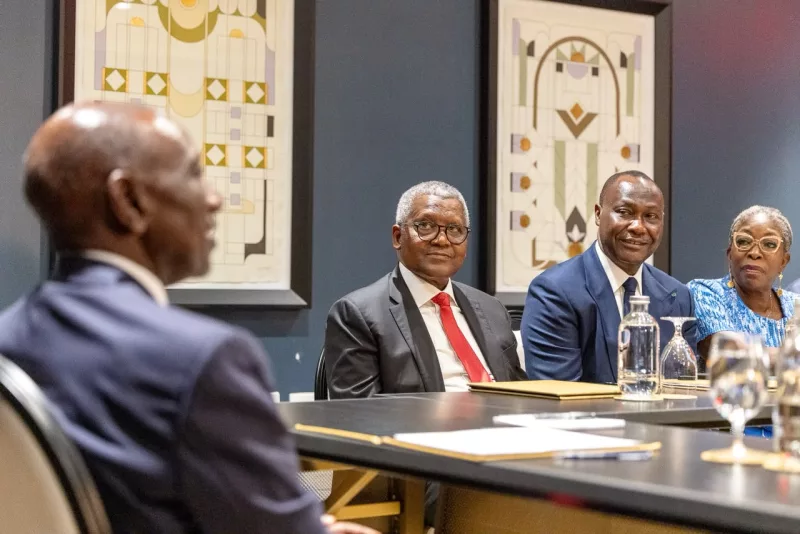
President William Ruto has announced that Kenya is ready to break ground on the East Africa refinery in Lamu, a project expected to boost regional energy security and support industrialisation. The refinery, being developed by Nigerian billionaire Aliko Dangote, will create new economic opportunities, strengthen regional supply chains, and position East Africa as a competitive energy and industrial hub. Ruto made the announcement after holding talks with Dangote Industries President and CEO Aliko Dangote and Africa Finance Corporation (AFC) CEO Samaila Zubairu on the sidelines of the United Nations General Assembly in New York.
The East Africa refinery is a $2.2 trillion project that will process 700,000 barrels of crude oil a day, making it the largest refinery in East Africa and one of Africa’s biggest. The project is expected to create more than 60,000 jobs, about half of them skilled, while anchoring a new petrochemical and industrial complex on the Coast. The refinery is designed to enhance the region’s energy security, deepen local value addition, create jobs, and advance Kenya’s industrialisation agenda.
Deputy President Kithure Kindiki chaired a high-level inter-ministerial and inter-agency meeting to prepare for the ground-breaking ceremony, which is set to take place on September 30. Kindiki described the project as a “one-in-a-generation investment” that will shift Kenya from being predominantly a fuel importer to becoming a regional processing and distribution hub. The project is also being designed around Lamu’s emerging role as the gateway to the Lamu Port-South Sudan-Ethiopia Transport (Lapsset) corridor.
The proximity of the refinery to a deep-water port provides an avenue for importing crude, exporting refined products, and developing storage, logistics, petrochemicals, and manufacturing around the facility. However, the project faces a fundamental feedstock test, with Kenya currently lacking commercial-scale crude production. Government advisers have estimated that East African producers could eventually provide more than 600,000 barrels per day, including roughly 350,000 barrels from South Sudan, 250,000 from Uganda, and 120,000 from Kenya.
Kenya spent about Sh511.5 billion on petroleum products last year, making fuel the country’s largest import bill. A domestic refinery of this scale could retain a substantial share of that value within the economy while reducing exposure to disruptions in international shipping routes and global crude and refined-product prices. The government is focused on moving the project from planning to implementation and ensuring it delivers economic benefits to people in the region.
President Ruto said the government is committed to turning this landmark project into reality and delivering tangible benefits for the people of the region. The refinery is expected to be completed by around 2030, with Dangote Industries leading the development. The project has been in the planning stages for several years, with the African Finance Corporation (AFC) playing a key role in securing financing for the project.
The East Africa refinery is a significant investment in the region’s energy sector and is expected to have a major impact on the economy. With the ground-breaking ceremony set to take place on September 30, the project is poised to move from planning to implementation, creating new opportunities for economic growth and development in the region.
Key points
- The project is expected to create more than 60,000 jobs and anchor a new petrochemical and industrial complex on the Coast.
- The refinery will process 700,000 barrels of crude oil a day, making it the largest refinery in East Africa.
- The project is set to be completed by around 2030.