On September 2, 2026, President William Ruto hosted a meeting at State House in Nairobi with representatives of micro, small, and medium enterprises (MSMEs), Trade Cabinet Secretary Lee Kinyanjui, and National Assembly Majority Leader Kimani Ichung'wah. The meeting aimed to address economic concerns, customs valuation issues, and market protection for local entrepreneurs. This gathering came amid protests by small-scale traders and hawkers in Nairobi, who were outraged by a decision by the Kenya Revenue Authority (KRA) to raise the minimum customs reference point for consolidated cargo containers.
The protests, which occurred on August 28, 2026, were sparked by a 28% increase in tax implemented by the KRA on August 20, 2026, which raised the minimum customs reference point from KSh 2.5 million to KSh 3.2 million. The traders warned that the increase would make importing goods unaffordable and potentially push the cost onto consumers already struggling with high living costs. Some leaders, including Embakasi North MP James Gakuya, openly criticized the government's tax measures and called for restrictions on foreign nationals competing in micro retail and informal trading.
During the meeting on September 2, 2026, President Ruto addressed the issue of foreign nationals competing with local traders. He stated that the government cannot allow people to come from China and set up shops selling the same products as MSME traders. He ordered a crackdown on foreign SMEs and hawkers, setting a deadline for enforcement on September 7, 2026. The President also instructed that the Local Content Bill, 2025, be fast-tracked to legally reserve specific micro trade categories for Kenyan citizens.
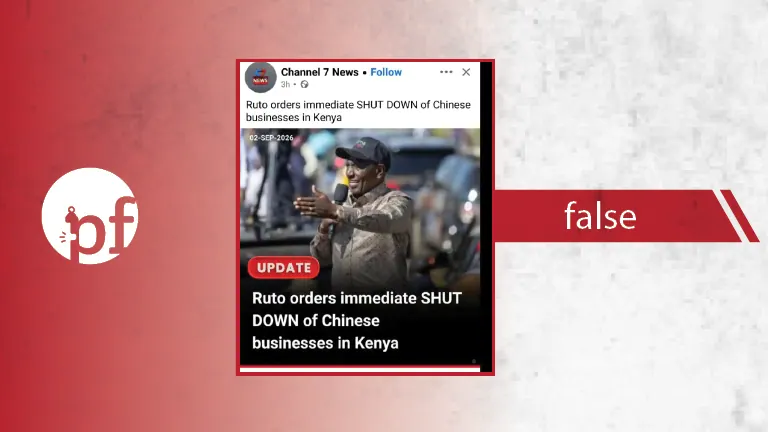
A Facebook post with a digital card attributed to Channel 7 News, dated September 2, 2026, claimed that President Ruto ordered an immediate shutdown of Chinese businesses in Kenya. However, a review of the official proceedings and video recordings of President Ruto's address revealed that his comments were specifically aimed at foreign nationals competing with local traders in micro retail and hawking.
The President did not order an immediate or total shutdown of all Chinese corporate investments, factories, construction firms, or large enterprises operating legally across Kenya. The claim that Ruto called for a blanket immediate shutdown of Chinese businesses in Kenya distorts the specific crackdown on foreign nationals competing with local traders.
Piga Firimbi, a fact-checking organization, verified the claim and found it to be false. The organization reviewed the official proceedings and video recordings of President Ruto's address at State House on September 2, 2026, and found that his actual words were taken out of context. The President's comments were specifically aimed at protecting local traders and MSMEs from unfair competition.
In conclusion, President William Ruto's remarks on Chinese businesses in Kenya were clarified to show that he did not order an immediate shutdown of all Chinese businesses. Instead, he targeted foreign nationals competing with local traders in micro retail and hawking, setting a deadline for enforcement on September 7, 2026. The claim that Ruto called for a blanket shutdown of Chinese businesses was found to be false.
Key points
- President William Ruto did not order an immediate shutdown of all Chinese businesses in Kenya.
- The President's comments were specifically aimed at foreign nationals competing with local traders in micro retail and hawking.
- The enforcement deadline for the crackdown on foreign SMEs and hawkers was set for September 7, 2026.