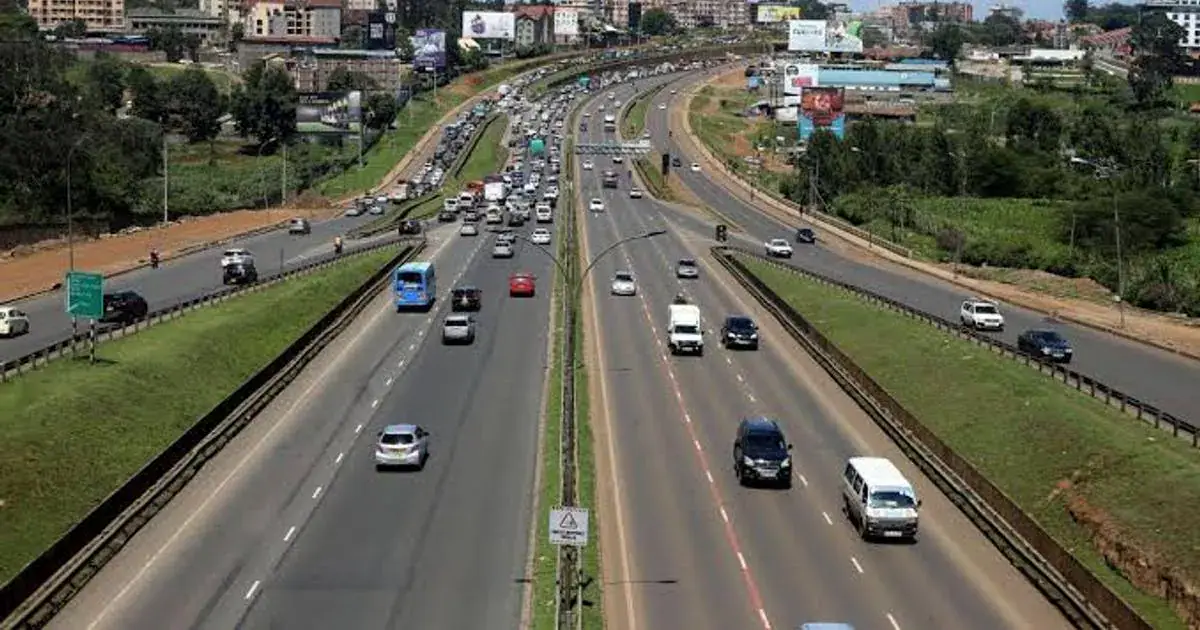
The Kenyan government is planning to construct a 60-kilometre elevated expressway that will connect Thika Town to Museum Hill in Nairobi. Preliminary estimates put the cost of the project between Sh150 billion and Sh200 billion. The proposed expressway will run above the existing Thika Superhighway, providing an additional route for motorists travelling between Thika and Nairobi. The project is expected to use private-sector financing to expand capacity along one of the capital's busiest commuter corridors.
The Thika Superhighway, an 8-to-12-lane controlled-access highway spanning 50 kilometres, was one of Kenya's major road infrastructure projects during former President Mwai Kibaki's administration. Its expansion transformed movement between Nairobi, Ruiru, Juja, and Thika, supporting residential development, businesses, educational institutions, and industrial activity along the corridor. However, population growth and rapid expansion of towns along the route have increased traffic volumes, causing congestion during peak periods.
The proposed expressway is expected to connect with the Nairobi Expressway around Museum Hill, potentially improving movement between the Thika corridor and other major routes through the capital. The Nairobi Expressway features state-of-the-art toll plazas operated by Moja Expressway, designed to streamline travel across Nairobi by bypassing standard traffic gridlocks. The Thika Road Expressway will provide additional road capacity without completely replacing the existing highway.
Deputy President Kithure Kindiki announced on October 30 that President William Ruto is expected to preside over the groundbreaking ceremony within one or two months. The project entered design and feasibility assessment in October 2026, which will examine the proposed alignment, engineering requirements, traffic capacity, construction costs, environmental and social impacts, and the amount of land required.
The government intends to pursue a Public-Private Partnership (PPP) arrangement to mobilise financing and deliver the infrastructure. Under a PPP, a private investor may finance, construct, and operate infrastructure under a contract with the public authority. Kenya has already used this model for the Nairobi Expressway, which was developed under a design-finance-build-operate-maintain-transfer arrangement with a 30-year contractual term.
The feasibility study will help establish whether the elevated road can be constructed along the existing corridor, where additional access or supporting infrastructure may be necessary, and how construction can be undertaken without causing excessive disruption to motorists. The findings will also inform the government's procurement and financing decisions. A project of this size requires more than a groundbreaking ceremony; it needs a financially viable agreement, appropriate environmental approvals, land arrangements, and a construction plan.
The government has not announced whether the proposed Thika Road Expressway will charge motorists a toll or how much a journey might cost. If the project adopts a toll-based PPP arrangement, the charges would need to be provided for under the final contract and applicable regulatory framework. The affordability of the final charges will be an important consideration for commuters who already spend significant amounts on daily transport.
Key points
- The project is expected to use private-sector financing to expand capacity along one of the capital's busiest commuter corridors.
- The proposed expressway will run above the existing Thika Superhighway, providing an additional route for motorists travelling between Thika and Nairobi.
- The government intends to pursue a Public-Private Partnership (PPP) arrangement to mobilise financing and deliver the infrastructure.