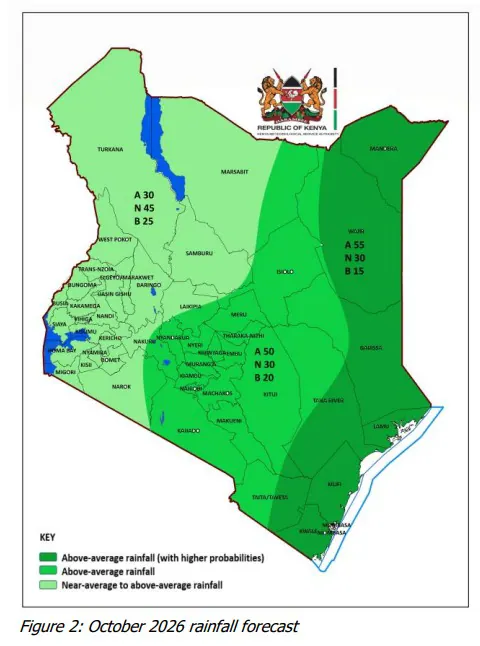
The Kenya Meteorological Service Authority (KMSA) has issued a monthly forecast warning of heavy rainfall in several parts of Kenya this month. The coastal and Northeastern region counties of Kwale, Mombasa, Kilifi, Lamu, Mandera, and parts of Taita Taveta, Tana River, Garissa, and Wajir Counties are expected to experience continued heavy rainfall. KMSA Director Edward Muriuki cautioned that the enhanced rainfall is likely to increase the probability of weather-related hazards.
According to the forecast, the Eastern region, the South-Eastern lowlands, and the Central region counties of Nairobi, Makueni, Kajiado, Machakos, Kiambu, Murang’a, Kirinyaga, Embu, Tharaka-Nithi, Meru, Isiolo, Nyandarua, Nyeri, and parts of Taita Taveta, Tana River, Garissa, Wajir, Marsabit, Laikipia, Nakuru, and Narok Counties are set for above-average rainfall. Muriuki warned that low-lying coastal zones, flood-prone river basins, urban centres with poor drainage, and steep highland areas are particularly vulnerable to the heavy rains.
The KMSA forecast also indicates that near-average to above-average rainfall is expected in the counties of Baringo, Bomet, Bungoma, Busia, Elgeyo Marakwet, Homa Bay, Kakamega, Kericho, Kisii, Kisumu, Migori, Nandi, Nyamira, Samburu, Siaya, Trans Nzoia, Turkana, Uasin Gishu, Vihiga, West Pokot, and parts of Narok, Nakuru, and Laikipia Counties during the month of October.
Muriuki warned that increased stagnant water may create favourable breeding conditions for mosquitoes, potentially increasing the transmission of vector-borne diseases such as malaria in susceptible areas. He also cautioned that flooded or poorly drained settlements may face higher risks of water-borne diseases where water quality and sanitation are compromised.
The heavy rains may disrupt road transport through flooding, waterlogging, and erosion of roads and bridges. Muriuki noted that rural access roads are particularly vulnerable to becoming impassable after sustained rainfall, while urban areas may also experience traffic disruptions when drainage systems are overwhelmed. However, he noted that above-average rainfall is likely to increase river flows, replenish dams, water pans, and groundwater resources.
The KMSA Acting Director said that in arid and semi-arid regions, the rains may contribute significantly to the recovery of water sources. However, he warned that heavy rainfall could increase runoff and cause localised flooding in some catchments, especially where drainage systems are inadequate. The above-average rainfall is expected to improve soil moisture, support land preparation and planting activities, enhance pasture regeneration, and improve water availability for livestock.
The onset and cessation dates provided by KMSA indicate that the lake basin and western rift valley counties will experience rainfall from September to January next year. The coastal counties already receiving rainfall will see the cessation in the second week of December, while the north eastern counties will experience rainfall starting this week and ceasing in the second week of December.
Key points
- Heavy rainfall is expected in several parts of Kenya this month, with flash floods, landslides, and infrastructural damage likely.
- The Kenya Meteorological Service Authority has warned of potential hazards, including increased risk of vector-borne diseases and water-borne diseases.
- Above-average rainfall is expected to improve soil moisture, support land preparation and planting activities, and enhance pasture regeneration.