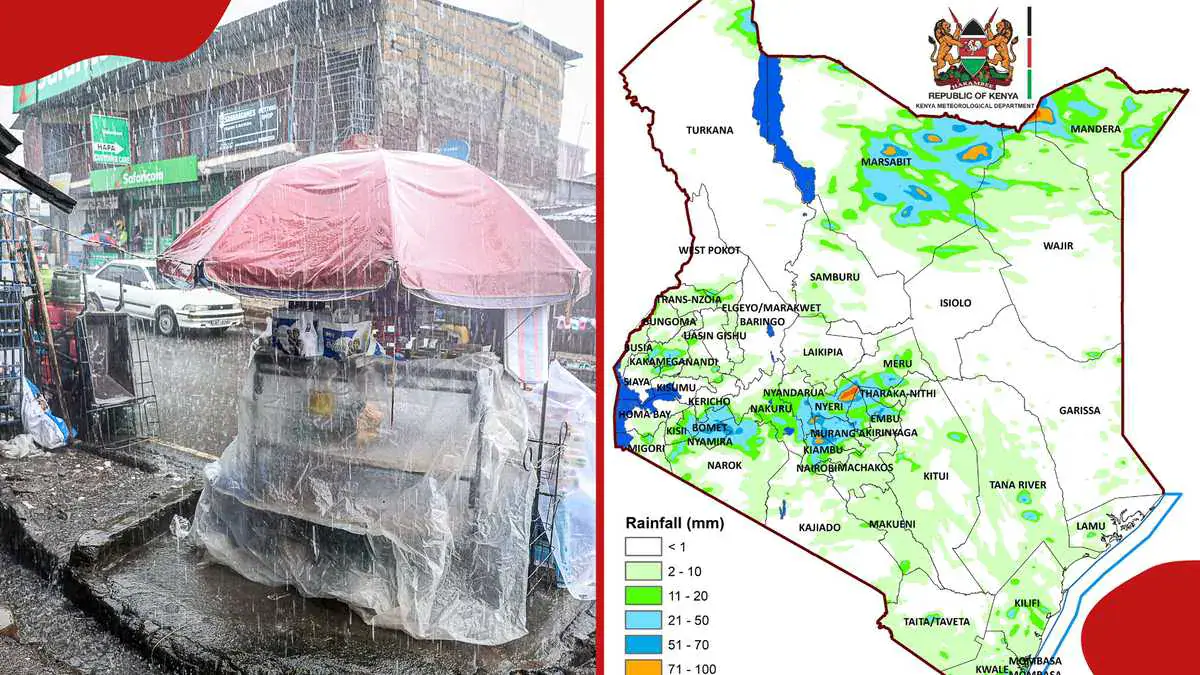
The Kenya Meteorological Department has released its monthly weather forecast for November 2026, covering rainfall and temperature across all counties. Above-average rainfall is expected across 44 counties, including Nairobi, Mombasa, Kisumu, and Meru, during the short rains season. This period is critical for agricultural production, water resource replenishment, and rural livelihoods. The forecast is particularly significant for farming communities in counties such as Meru, Tharaka-Nithi, Embu, Murang'a, and Busia, which typically record substantial rainfall during this window.
November falls within the October–November–December short rains season. The Kenya Meteorological Department warned that most of the country will experience above-average rainfall and warmer-than-normal temperatures throughout the month. Counties expected to receive above-average rainfall include Nairobi, Mombasa, Kisumu, Nakuru, Machakos, Makueni, Kitui, Garissa, Mandera, Wajir, Laikipia, Lamu, Kwale, Kilifi, Taita Taveta, Tana River, Homa Bay, Migori, Siaya, Trans Nzoia, Uasin Gishu, Nandi, Vihiga, Kakamega, Bungoma, Busia, Kericho, Bomet, Narok, Nyamira, Kisii, Kajiado, Kiambu, Kirinyaga, Murang'a, Nyeri, Nyandarua, Meru, Embu, Tharaka-Nithi, Isiolo, Baringo, and much of West Pokot, Samburu, and Marsabit counties.
Parts of Turkana, West Pokot, Samburu, Baringo, and Marsabit counties are likely to receive near-average to above-average rainfall. The department attributed the expected rainfall patterns to several large-scale climate drivers, including the Indian Ocean Dipole, the El Niño–Southern Oscillation, the Madden–Julian Oscillation, and tropical cyclone activity over the Indian Ocean. These climate drivers are expected to contribute to the above-average rainfall in various parts of the country.
Mean temperatures across all counties are projected to be warmer than the historical average for November. The department provided county-by-county maximum and minimum temperature ranges. Counties in the Rift Valley and western region, including Nandi, Kakamega, Vihiga, Bungoma, Siaya, Busia, Baringo, Nakuru, Trans Nzoia, Uasin Gishu, Elgeyo Marakwet, West Pokot, Kisii, Nyamira, Kericho, Bomet, Kisumu, Homa Bay, Migori, and Narok, are forecast to record maximum temperatures of between 20°C and 30°C.
The temperature forecast also indicates that Turkana and Samburu counties face the widest temperature range, with maximums of up to 38°C and minimum temperatures as low as 8°C. Similarly, Marsabit, Mandera, Wajir, Garissa, and Isiolo counties are forecast to hit maximums of 38°C, with night-time lows between 15°C and 28°C. Central counties and Nairobi, covering Nyandarua, Laikipia, Nyeri, Kirinyaga, Murang'a, Kiambu, Meru, Embu, and Tharaka-Nithi, are expected to record maximums of between 20°C and 30°C.
The coast, covering Mombasa, Kilifi, Lamu, Kwale, and the Tana Delta, will remain the warmest zone at night, with minimum temperatures forecast between 20°C and 25°C and maximums ranging from 25°C to 35°C. The Kenya Meteorological Department's forecast is critical for various sectors, including agriculture, water, and disaster management. The department's warning of above-average rainfall and warmer temperatures will help stakeholders prepare for the potential impacts.
The Kenya Meteorological Department's November 2026 weather forecast highlights the need for preparedness and vigilance among communities in various counties. With above-average rainfall expected in 44 counties, residents are advised to take necessary precautions to mitigate the potential impacts of the rains. The department's forecast is a critical tool for planning and decision-making in various sectors.
Key points
- Above-average rainfall is expected in 44 counties, including Nairobi, Mombasa, Kisumu, and Meru.
- Mean temperatures across all counties are projected to be warmer than the historical average for November.
- The department attributed the expected rainfall patterns to several large-scale climate drivers, including the Indian Ocean Dipole and El Niño–Southern Oscillation.