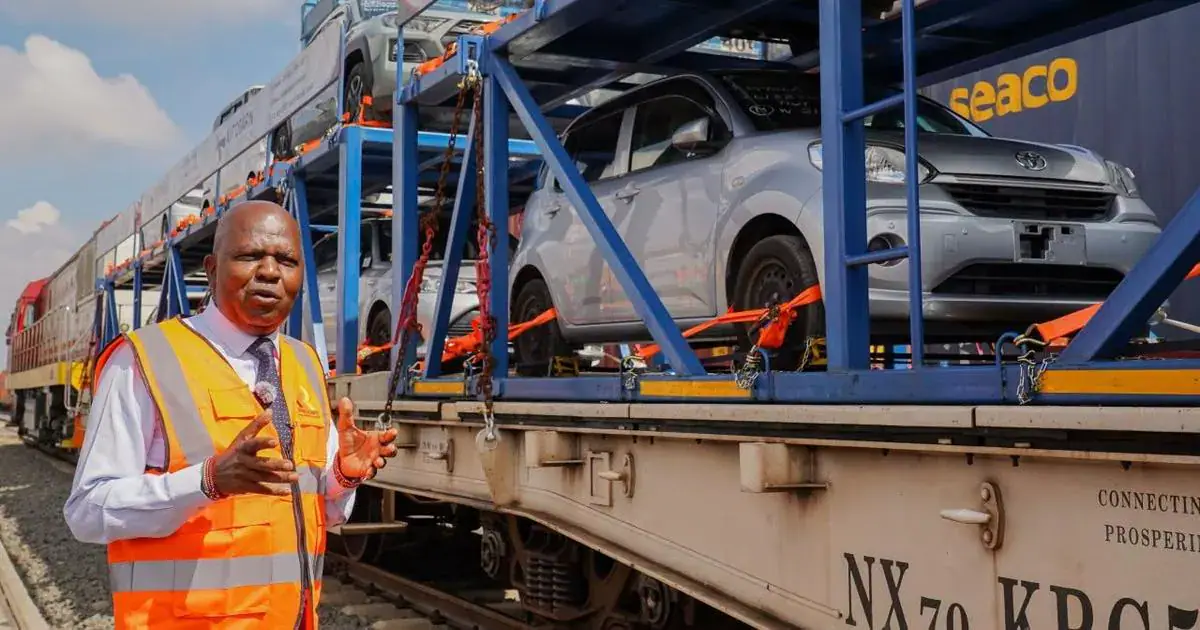
Kenya Railways has launched a dedicated vehicle-haulage service connecting the Port of Mombasa to Nairobi's Inland Container Depot. The service offers car importers, dealers, and private motorists an alternative to long-distance road transport. For decades, imported vehicles arriving at the Port of Mombasa have largely depended on road transport to reach Nairobi dealerships, showrooms, and buyers across the country. The new service aims to reduce congestion and wear on major highways.
The inaugural train departed Mombasa Port on October 29 and arrived at the Nairobi Inland Container Depot in Embakasi within eight hours. The initial consignment carried 21 vehicles on four specially fabricated car-carrier wagons, alongside 34 flatbed wagons transporting shipping containers. The service was handled in partnership with vehicle dealer Autobarn East Africa, which is among the businesses expected to use the service as Kenya Railways expands its freight operations.
The car-carrier wagons are specifically built to accommodate motor vehicles, with each wagon capable of carrying up to six cars. The wagons are designed to handle different makes of vehicles, including Toyota, Nissan, Honda, Suzuki, Volkswagen, Mazda, and Daihatsu. Vehicles are loaded onto the specialized carriers and secured before the train departs. The arrangement is intended to reduce the mileage accumulated during road transportation and minimize exposure to unnecessary wear and tear.
The service is designed for several categories of customers, including vehicle importers and clearing agents, car dealerships and distributors, vehicle manufacturers and fleet operators, and private motorists. The service is not limited to large commercial importers, and private motorists can make enquiries directly with Kenya Railways. The vehicle-haulage arrangement is a freight service, and motorists do not board the train with their vehicles.
Kenya Railways reported that the inaugural vehicle-haulage journey took approximately eight hours between Mombasa Port and the Embakasi ICD. This compares favorably with road transportation, which can take considerably longer depending on traffic, weather, road conditions, and the route used. The railway operator says moving vehicles by rail can also reduce congestion and wear on major highways, particularly along the busy Nairobi-Mombasa corridor.
Kenya Railways has not published a standard per-vehicle transport tariff in its launch announcement. The final cost should be confirmed directly with the corporation and may depend on the vehicle, route, insurance arrangements, and additional services requested. Importers should obtain a quotation covering transport, vehicle securing, insurance, and any customs-processing arrangements before committing to the service.
The corporation can provide the applicable rates, booking requirements, vehicle acceptance details, and departure arrangements. Kenya Railways is also targeting the regional market, including vehicle importers and traders in the Democratic Republic of Congo, Rwanda, South Sudan, Burundi, Uganda, and Tanzania. The target is to move approximately 700 vehicles every month through the new arrangement.
Key points
- Kenya Railways launches vehicle-haulage service on SGR
- The service aims to reduce congestion and wear on major highways
- The inaugural journey took approximately eight hours between Mombasa Port and Nairobi ICD